About Sittasomus griseicapillus (Vieillot, 1818)
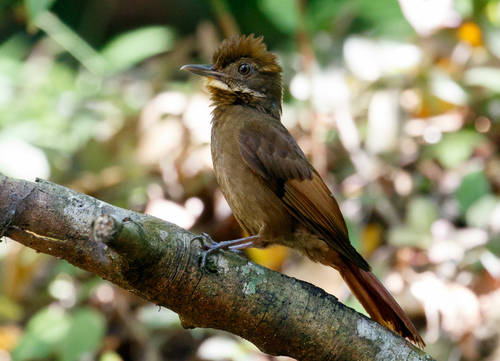
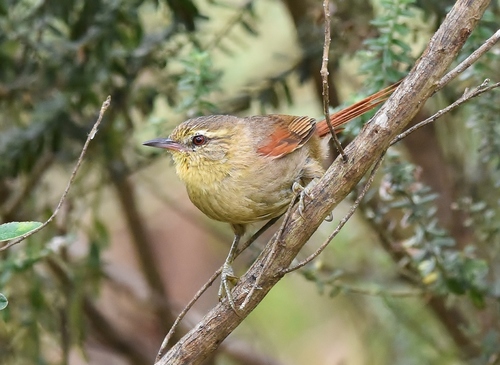
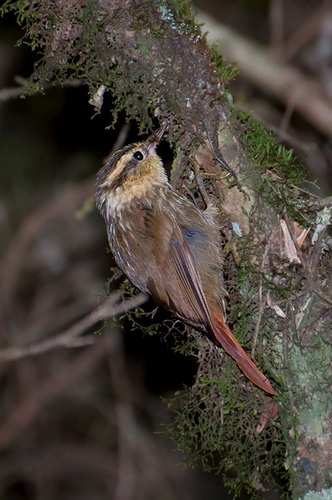
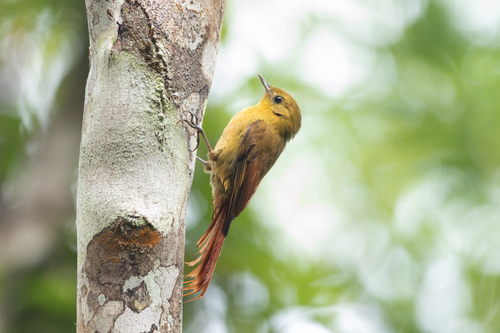
The olivaceous woodcreeper (Sittasomus griseicapillus) is one of the smallest members of the woodcreeper subfamily. It has a slim body and a short straight bill, and unlike most other woodcreepers, it has no streaks or spots on its plumage. The sexes have identical plumage, but females are on average smaller than males. Adult individuals measure 13.1 to 19.3 cm (5.2 to 7.6 in) in length. Males weigh 9.0 to 18.0 g (0.32 to 0.63 oz), and females weigh 8.6 to 16.0 g (0.30 to 0.56 oz). Both length and weight vary across different geographic regions. All subspecies share consistent physical traits: a dark iris, a dark gray to black upper mandible (maxilla), a black to light gray lower mandible (mandible) with a darker tip, and gray, bluish gray, or black legs and feet. The nominate subspecies S. g. griseicapillus is mostly olivaceous, with an olive-brown hindcrown and rufous rump, tail, and flight feathers. Its vent area is grayish, and its flanks are buff. A tawny band is visible on the wing when the bird is in flight. Other subspecies in the "Amazonian" subspecies group are similar to the nominate, with the following differences: S. g. amazonus is darker and grayer, has whitish wingpits, and more rufescent tail and flight feathers; S. g. axillaris has a more rufescent back, ochraceous wingpits, and more rufescent flight feathers; S. g. viridis has a more olive-green back and a paler, more yellowish green vent area; S. g. transitivus is grayer and has a cinnamon wing band. The six subspecies of the "grayish" group are mostly olive, with a contrasting brown back, and rufous wings and tail. Subspecies in this group vary slightly: the olive-colored areas tend toward gray in some, the brown back can be somewhat reddish or deeper brown in others, and the wing band ranges among whitish, buff, or tawny. The two subspecies of the "olivaceous" group are overall olive-yellow, with deep rufous tails and flight feathers. S. g. sylviellus tends toward mustard yellow, while S. g. olivaceus is more olive. The "Pacific" subspecies S. g. aequatorialis is similar to the "grayish" group, but has a browner back and pale tawny tail and flight feathers. "Reiser's" subspecies S. g. reiseri has a cinnamon-brown hindcrown, head, and mantle. Its tail and flight feathers are pale but rich rufous, its wingpits are ochraceous, its flanks are cinnamon, and its vent area is cinnamon-buff. Different subspecies of the olivaceous woodcreeper have distinct distributions: S. g. jaliscensis is found in Mexico north of the Isthmus of Tehuantepec; S. g. gracileus is found on Mexico's Yucatan Peninsula, in northern Guatemala, and in northern Belize; S. g. sylvioides is found in Mexico south of the Isthmus of Tehuantepec, and extends south through Central America into northwestern Colombia; S. g. perijanus is found in northeastern Colombia and northwestern Venezuela; S. g. tachirensis is found in northern Colombia and western Venezuela; S. g. griseus is found in Tobago and in Venezuela's eastern Andes and coastal mountain ranges; S. g. aequatorialis is found on the Pacific slope from western Ecuador south into northwestern Peru; S. g. amazonus is found in the western Amazon Basin of southeastern Colombia, southern Venezuela, eastern Ecuador and Peru, and western Brazil east to the Negro and Madeira rivers; S. g. axillaris is found in the northeastern Amazon Basin from southwestern Venezuela east to Guyana, and south in Brazil to the Amazon River; S. g. viridis is found in the Amazon Basin in Bolivia; S. g. transitivus is found in Amazonian Brazil south of the Amazon River, east of the Rio Tapajós, and south into Mato Grosso; S. g. griseicapillus is found from southeastern Bolivia east across central Brazil and south through Paraguay into north-central Argentina; S. g. reiseri is found in northeastern Brazil; S. g. olivaceus is found in southeastern Bahia state in eastern Brazil; S. g. sylviellus is found in southeastern and southern Brazil, southeastern Paraguay, and northeastern Argentina and Uruguay. The olivaceous woodcreeper lives in a variety of wooded landscapes, generally favoring all parts of mature forest, but also occurring in secondary forest and plantations. Mature landscapes it inhabits include rainforest, semi-deciduous forest, terra firme and várzea forests, evergreen montane forest, cloudforest, and gallery forest. In drier areas, it occurs in scrublands, caatinga, and cerrado. It has also been recorded in stands of bamboo, pine forest, mangroves, coffee plantations, and urban parks. The species occupies a range of elevations. In northern Central America, it occurs from sea level to 1,950 m (6,400 ft). Subspecies S. g. axillaris is fairly common between 1,200 and 1,400 m (3,900 and 4,600 ft) and is found as low as 850 m (2,800 ft). In Colombia, it occurs below 2,000 m (6,600 ft), and in Ecuador it is found mostly below 1,100 m (3,600 ft) but can reach as high as 2,000 m (6,600 ft). It reaches an elevation of up to 2,300 m (7,500 ft) in northern Venezuela, Bolivia, and southeastern Brazil.