About Sitta whiteheadi Sharpe, 1884
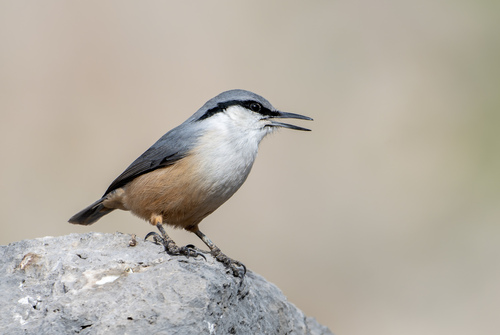
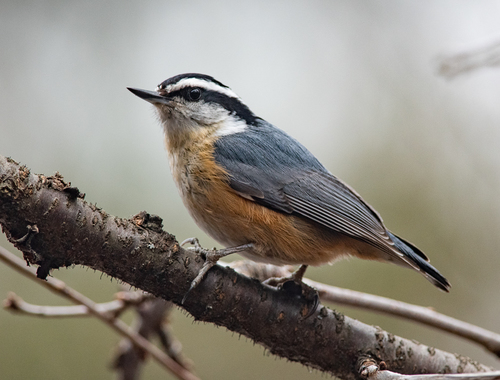
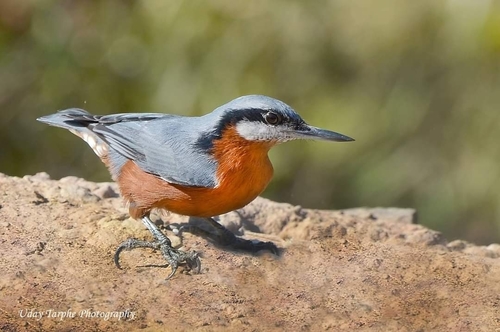
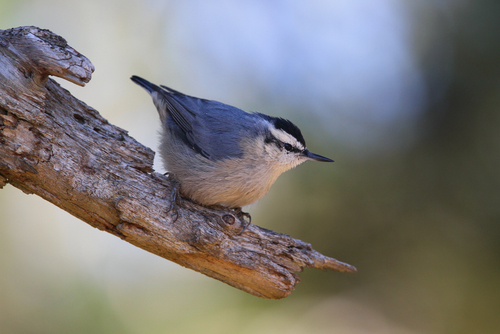
The Corsican nuthatch, with the scientific name Sitta whiteheadi Sharpe, 1884, is a bird species that belongs to the nuthatch family Sittidae. It is a relatively small nuthatch, reaching approximately 12 cm (4.7 in) in total length. Its upperparts are bluish-grey, and its underparts are greyish-white. Males can be distinguished from females by their fully black crown. This species is sedentary, territorial, and not very shy. It often feeds at height in Corsican pines (Pinus nigra var. corsicana, synonym P. nigra subsp. laricio), with pine seeds making up the majority of its diet, though it also catches some flying insects. Breeding occurs between April and May; nests are built in the trunks of old pines, and clutches contain five to six eggs. Young birds fledge 22 to 24 days after hatching. The Corsican nuthatch is found only on the island of Corsica, where it inhabits old high-altitude Corsican pine forests, and moves to lower elevations during winter. Its scientific name honors John Whitehead, the ornithologist who brought this species to the attention of the scientific community in 1883. The Corsican nuthatch is closely related to the Chinese nuthatch (S. villosa) and the red-breasted nuthatch (S. canadensis). It faces threats from the loss of nesting sites and habitat fragmentation, with an estimated total population of around 2,000 individuals that is likely experiencing a moderate decline. Due to its small population and limited range, the International Union for Conservation of Nature classifies the Corsican nuthatch as vulnerable. The Corsican nuthatch is the only bird species endemic to Corsica, and also the only bird species endemic to metropolitan France. Its range covers most of the island, which is heavily mountainous. The species occurs from the Tartagine-Melaja forest in the north to the Ospedale forest in the south, and is particularly abundant in the Monte Cinto, Monte Rotondo, Monte Renoso, and Monte Incudine massifs. There are also two isolated populations: one in Castagniccia in the island’s northeast, and another on Cagna mountain in the south. The Corsican nuthatch prefers Corsican pine (Pinus nigra var. corsicana) forests broken up by clearings. Its Mediterranean climate habitat is fairly dry during summer, with three weeks to two months of drought, and receives heavy rainfall and/or snow in winter, for an annual total of 800–1,800 mm (31–71 in). This nuthatch is sedentary. Between April and October, it generally lives in deep valleys between 1,000 m (3,300 ft) and 1,500 m (4,900 ft) above sea level, though it can be found between 750–1,800 m (2,460–5,910 ft); more open forests at higher elevations are less suitable habitat. It moves to lower elevations in winter, and may then occupy mixed forests of Corsican pine and maritime pine (Pinus pinaster) or silver fir (Abies alba) forests, though its stand indices are significantly lower here than in pure Corsican pine forests. It avoids hardwood-dominated or mixed woodlands. Old pines provide the nuthatch with abundant food, and the species is not found in areas where trees are less than 28 cm (11 in) in diameter, or where Corsican pines make up a minority of trees compared to other species. Sites that are most likely to host Corsican nuthatches have large trees over 16 m (52 ft) tall with diameters over 58 cm (23 in). The bird’s preference for Corsican pine over maritime pine may be explained by the tougher seeds of maritime pine. In a 2002 historical analysis, Thibault and colleagues noted that the Corsican nuthatch and Corsican pine, which have likely been present on the island since at least the middle of the Quaternary, had to survive the last climatic fluctuations of the Pleistocene that caused major changes to vegetation composition and distribution. It is likely that the nuthatch survived this entire period in Corsican pine forests. Like all nuthatches, the Corsican nuthatch can climb head-first along branches and is rarely found on the ground. It is territorial and not shy. It lives in permanent monogamous pairs that occupy the same three to ten hectare territory year-round, with both pair members defending the territory from intruders of the same or other species. The home range, the area birds typically use within their territory, varies in size based on season, bird age, and most importantly, pine cone production. The Corsican nuthatch eats mainly pine seeds, but also consumes small insects during summer. From March to November, small arthropods including adult insects, insect larvae, and spiders make up the majority of its diet. It catches these prey in flight, but more often forages for them on trees; around one quarter of its captures are made in flight from a lookout post, and the rest are taken from tree surfaces. In spring and summer, it is more often found in treetops, foraging high in pine foliage at the ends of branches in a manner similar to tits. In autumn, it forages along tree trunks and large branches, and may join mixed-species feeding flocks with other small passerines outside of the breeding season. November marks the start of pine cone opening, and the Corsican nuthatch extracts seeds from cones using its slender bill. In years with high cone production, the nuthatch can rely on cones for food until March. Like many other nuthatches, the Corsican nuthatch caches extra seeds under bark, lichens, or plant debris, to eat during lean seasons. This caching behavior is especially useful when early spring snow blocks access to pine cones, or when cones stay closed on cold, wet days. This use of food caches may also partially explain why the species is fully sedentary.