About Sitta villosa J.Verreaux, 1865
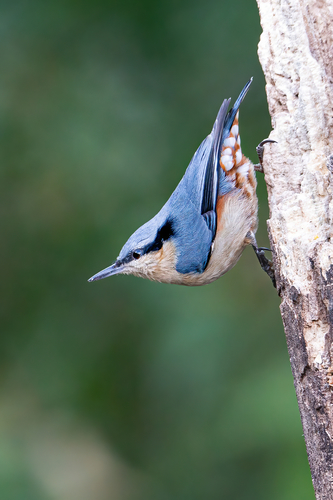
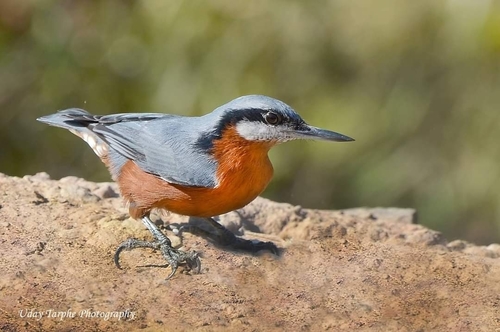
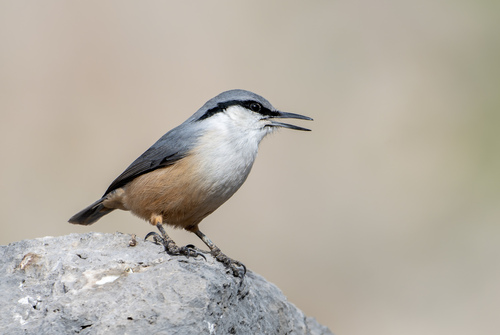
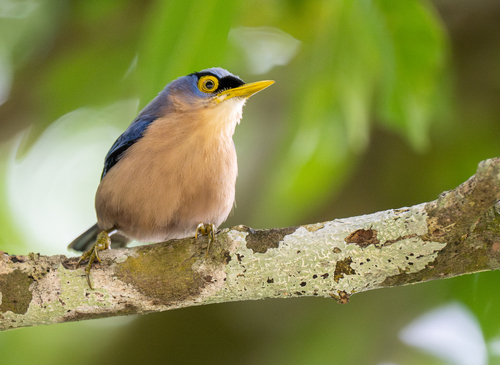
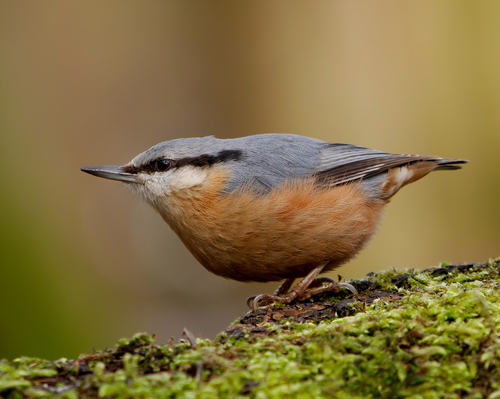
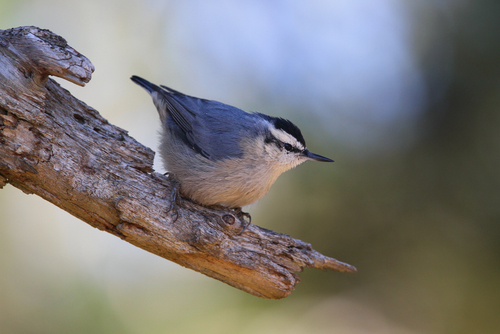
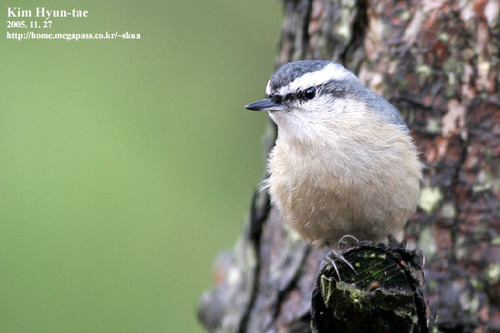
The Chinese nuthatch, also called the snowy-browed nuthatch, with the scientific name Sitta villosa J.Verreaux, 1865, is a small bird species in the family Sittidae. It reaches 11.5 cm (4.5 in) in length. Its upperparts are blue-grey, while its underparts range from dull buff-greyish to cinnamon-orange, and its cheeks are white. This species shows clear sexual dimorphism: adult males have a distinct black crown, while females have a crown that matches the blue-grey of their back, or is at most dark grey when plumage is worn. A dark grey eyestripe extends both in front of and behind the eye in both sexes, topped by a clear white supercilium that separates the eyestripe from the crown. The Chinese nuthatch’s song is variable, made up of repetitions of small, consistent whistles. In summer, the species feeds mainly on insects, and supplements its diet with seeds and fruits during other seasons. Its nest is typically placed in a conifer tree hole. Breeding pairs raise one brood per year, which contains five or six chicks. Three regional subspecies with slightly different coloration are recognized for this species. Phylogenetically, the Chinese nuthatch is related to the Corsican nuthatch (S. whiteheadi), and both species are closely related to the North American red-breasted nuthatch (S. canadensis). The Chinese nuthatch is native to an area ranging from central and northeastern China to Korea, and the extreme southeast of Russia. It has been reported on the Russian island of Sakhalin, but is likely only a vagrant there. Within China, its range extends from eastern Qinghai in the west to southeastern and central Gansu, most of Shaanxi, Shanxi, southern Liaoning on the Liaoning peninsula, northern Hebei, Beijing Municipality, and northern Sichuan. It has been recorded in northern North Korea, with some individuals dispersing into surrounding areas in autumn; it has been observed in North Hamgyong from July to August, and in North Kyongsang (including North P'yongan) from May to November. It is a very rare winter visitor to South Korea, with historical records from the mountains of Kyonggi between October and March (and one July 1917 record) and North Kyongsang in November; the only recent South Korean record comes from the Kwangnung Experimental Forest near Song, Kangwon province, from March 1968. On the Korean peninsula, this nuthatch is closely associated with Japanese Red Pine (Pinus densiflora) forests. In China, it inhabits coniferous forests made up of Pinus and Picea species, sometimes mixed with oaks (Quercus) and birches (Betula). In summer 2006, a Dutch entomological expedition incidentally observed a pair of nuthatches nesting in the Altai, near the border crossing of China, Kazakhstan, Mongolia, and Russia. The nest was located in a pure Siberian larch (Larix sibirica) forest at 2,150 m altitude. The observers noted the male had a black crown, the female lacked a black crown, and both individuals had a distinct dark eyestripe topped by a white supercilium. While the Eurasian nuthatch subspecies S. e. asiatica occurs in this region, the observers stated that the male’s black crown and the small size of the observed individuals ruled out misidentification as this Eurasian species. The geographically closest species matching this description is the Chinese nuthatch, though this observation would place the pair 1,500 km (930 mi) outside the species’ known breeding range, and the observed individuals had less buffy underparts than typical Chinese nuthatches. The observers suggested this record could indicate the Chinese nuthatch has a much wider distribution than previously known, or that the birds belong to an undescribed species closely related to S. whiteheadi and S. villosa. The fact that these two related species have ranges separated by 7,000 km (4,300 mi) is similar to the distribution of the two Cyanopica blue magpie species: the azure-winged magpie (C. cyanus) of eastern Asia, and the Iberian magpie (C. cooki) of Portugal and Spain. The exact identity of the Altai breeding pair requires further targeted research. The discovery and description history of the Algerian nuthatch demonstrates how difficult it can be to detect and describe highly isolated nuthatch populations. In June 2017, during the breeding season, two Swiss ornithologists searched for this nuthatch at the 2006 reporting site, spending five nights surveying surrounding forests from the tree line down to the valley floor. They identified three breeding pairs of the local subspecies S. europaea asiatica with at least one to two young, and found this was the only nuthatch species present in the area. All adult nuthatches detected responded to conspecific song playback while foraging, and most were first located by their call or song. The authors concluded the 2006 sighting was most likely of the local Eurasian nuthatch subspecies, which may have had unusual plumage, or abraded or stained feathers. In summer, the Chinese nuthatch feeds almost entirely on insects, which are also the only food provided to its young. Studies in China have found that between April and August, 98.5% of the species’ diet is made up of insects, including beetles (Coleoptera), Hymenoptera, butterflies, bugs (Heteroptera), Homoptera (including aphids and Cicadidae), Neuroptera and flies (Diptera). The Chinese nuthatch handles larger insects by holding them with its legs and shredding them with its bill, and can also catch insects in flight. Like other nuthatch species, it stores food for later use. In winter, its diet consists primarily of nuts, seeds, and tree fruits. In winter, the Chinese nuthatch often joins mixed-species foraging flocks, and is typically seen in pairs within these flocks. Because the species has a very large range and its population does not appear to be declining significantly, the International Union for Conservation of Nature lists the Chinese nuthatch as a species of least concern.