About Sitta pygmaea Vigors, 1839
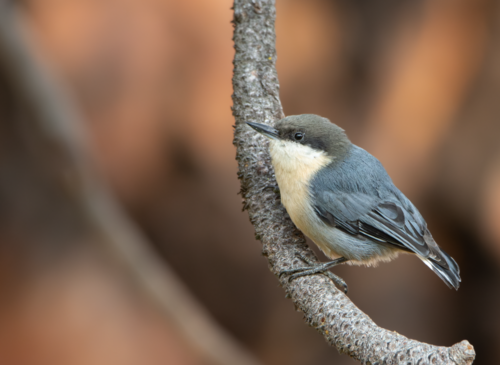
Sitta pygmaea, commonly called the pygmy nuthatch, measures 9–11 cm (3.5–4.3 in) in length, has a 19.7 cm (7.8 in) wingspan, and weighs 9.3–11.4 g (0.33–0.40 oz). Its distribution extends from southern British Columbia, south through scattered discontinuous regions of the western United States including the northwest U.S., the Sierra Nevada range, and the southern Rockies, all the way to central Mexico. It typically inhabits pine forests, especially ponderosa pine, as well as douglas-fir and other coniferous forests. Pygmy nuthatches climb acrobatically through the foliage of these trees to feed on insects and seeds. They only rarely creep along tree trunks or larger limbs, which is the more typical behavior of larger nuthatch species. Pygmy nuthatches build their nests inside cavities in dead conifer stubs. They line the base of the nesting cavity with pine cone scales, plant fibers, and other soft plant and animal materials. They may plug cracks or crevices around the cavity entrance with fur, though the purpose of this behavior has not been determined. Females lay between 4 and 9 eggs, which are white with fine reddish-brown spots. The female performs most of the incubation, which lasts around 16 days. Young pygmy nuthatches fledge and leave the nest approximately 22 days after hatching. This species is highly social. A breeding nesting pair often receives help raising young from other helper birds. Outside of the breeding season, pygmy nuthatches travel in noisy, wandering flocks. They also roost communally; gatherings of over 100 birds have been observed huddled together in a single tree cavity. All plumage stages of this species look similar: individuals have a warm gray cap, blue-gray upper body plumage, and whitish underparts. A distinct whitish spot is present on the nape, and this spot is particularly visible in worn summer plumage. When in flight, the tail shows a white subterminal band. The vocalizations of the pygmy nuthatch are a highly varied mix of chirps, peeps, and chattering. Currently, six subspecies of Sitta pygmaea are accepted. Some older sources recognize a seventh subspecies, S. p. chihuahuae, which is now treated as a synonym of Sitta pygmaea melanotis. The accepted subspecies are as follows: Sitta pygmaea melanotis described by Van Rossem A.J. in 1929, distributed from southwestern Canada, south through the interior western United States to northwestern Mexico; Sitta pygmaea pygmaea described by Vigors N.A. in 1839, found on the central California coast; Sitta pygmaea leuconucha described by Anthony A.W. in 1889, found on the southwestern California coast; Sitta pygmaea brunnescens described by Norris R.A. in 1958, found in southwestern Mexico; Sitta pygmaea flavinucha described by Van Rossem A.J. in 1939, found in east-central Mexico; and Sitta pygmaea elii described by Phillips A.R. in 1986, found in northeastern Mexico. This species is very closely similar in appearance to the brown-headed nuthatch, which inhabits the southeastern United States. The ranges of these two species do not overlap. The brown-headed nuthatch can be distinguished by its orangey-brown cap rather than the pygmy nuthatch's grayish cap, it has a more prominent white nape spot, and it shows less white coloration on its tail.