About Sitta pusilla Latham, 1790
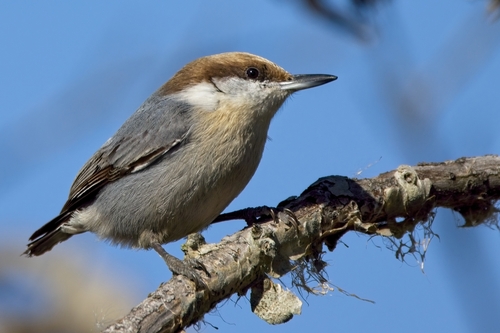
The brown-headed nuthatch, with the scientific name Sitta pusilla Latham, 1790, is a small songbird that lives only in pine forests across the Southeastern United States. Genetic analysis has shown low differentiation between northern and southern populations in Florida, but south Florida populations have lower genetic diversity, which may result from the documented increased habitat fragmentation in the region. The Bahama nuthatch was formerly classified as a subspecies of the brown-headed nuthatch (S. p. insularis), but has since been reclassified as a separate full species. Two recent studies that compared vocalizations between Bahama and continental nuthatch populations found important differences. One study also showed that continental and Bahama populations did not respond aggressively to the other population’s calls; this type of call-response study is commonly used to help identify cryptic species. Like other nuthatches, the brown-headed nuthatch has a sharp, black, nail-like beak that it uses to pound open seeds. It often visits feeding stations and strongly prefers sunflower seeds and suet cakes. This species is bold and inquisitive, and is easily approached by humans. Brown-headed nuthatches have regularly been observed holding small bark chips, small twigs, and pine needles in their beaks to use as tools for digging out insects. They also display other unusual behaviors, including cooperative breeding: groups of 3 to 5 adults provide care for a single nest. Recent genetic studies suggest that some of the assumed non-breeding adults in these groups may actually breed with individuals in neighboring territories. This nuthatch also displays a range of other social behaviors, including social grooming and male-female duets similar to those seen in the pygmy nuthatch. Brown-headed nuthatches prefer to build their nests at the top of short dead snags. Despite the name of the pygmy nuthatch, the brown-headed nuthatch is around the same size as the pygmy nuthatch, and the two species are the smallest nuthatches in the world. Brown-headed nuthatches measure 9–11 cm (3.5–4.3 in) in total length, have a wingspan of 16–18 cm (6.3–7.1 in), and weigh 10–12 g (0.35–0.42 oz). This species has a brown cap, a narrow black eyeline, and buff white cheeks, chin, and belly. Its wings are bluish-gray, and there is a small white spot at the nape of its neck. The bird’s call is a sharp whee-hyah, which sounds very similar to the noise made by a rubber duck toy, and is surprisingly loud for a bird of this size. It also makes softer "pit pit pit" calls during flight, as well as other squeaking sounds. When seen or heard clearly, this species is almost impossible to misidentify in the wild, because it only shares range with the larger, very differently marked red-breasted and white-breasted nuthatches.