About Sitta nagaensis Godwin-Austen, 1874
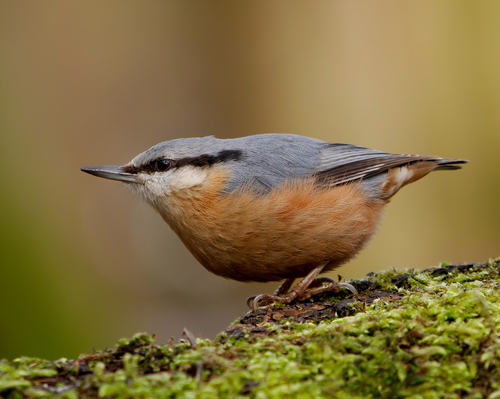
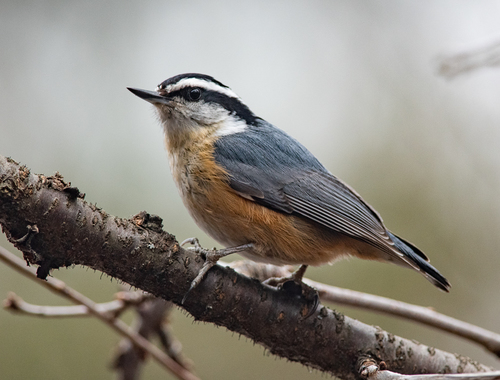
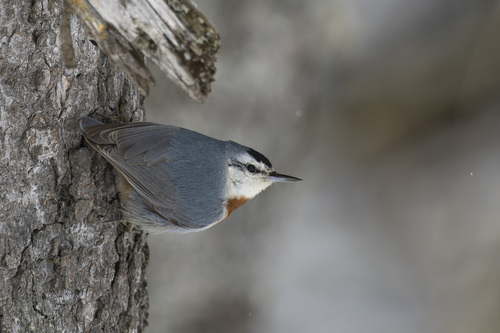
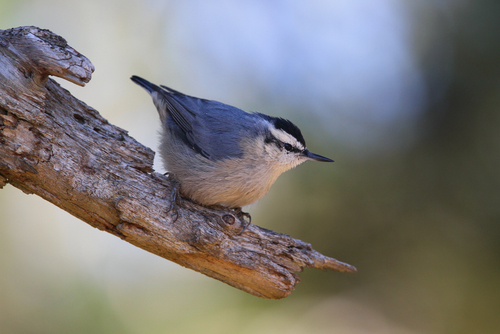
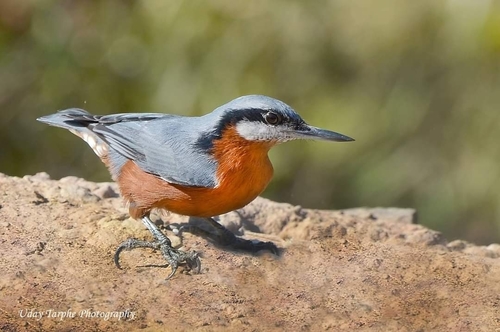
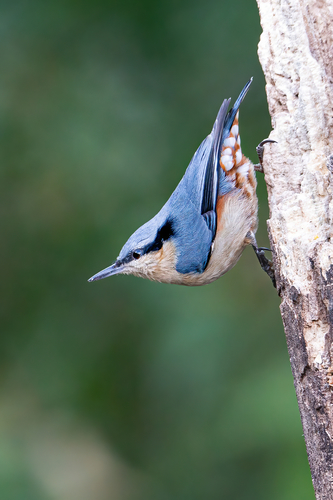
The chestnut-vented nuthatch, with the scientific name Sitta nagaensis, is a bird species belonging to the nuthatch family Sittidae. It is a medium-sized nuthatch, measuring 12.5–14 cm (4.9–5.5 in) in total length. Its upperparts are solid grey-blue, and it has a distinctively black loral stripe. Its underparts are a uniform grey to buff from the throat through the belly, with brick red coloring on the flanks. The undertail coverts are white with a rufous border. The chestnut-vented nuthatch produces multiple types of calls, which can sometimes sound similar to a wren's alarm call, while its song is a monotonous, stereotyped crackle that typically follows a chichichichi pattern. Little is currently known about this species' ecology, but it is thought to feed on small arthropods and seeds. Its breeding season starts between March and May. Nests are usually placed in a hole in a tree trunk, and clutches contain two to five eggs. The chestnut-vented nuthatch is distributed across northeast India, parts of Tibet, and south-central China, and its range extends south into eastern Myanmar and northwestern Thailand. Isolated populations also occur in southern Laos and Vietnam. The species primarily inhabits evergreen forests or pine forests, but can also be found in mixed or deciduous forests. Its natural habitats are classified as subtropical or tropical moist lowland forests, and subtropical or tropical moist montane forests. Its altitudinal range varies by location, spanning from 915–4,570 m (3,002–14,993 ft) overall. This species was first described in 1874 by British naturalist Henry Haversham Godwin-Austen, who gave it the name Sitta nagaensis after the Naga Hills, where the original type specimen was collected. It is part of the S. europaea species group, which also includes the Kashmir nuthatch (S. cashmirensis) and the Eurasian nuthatch (S. europaea); all species in this group line their nest entrances with mud. While the total population size of the chestnut-vented nuthatch is unknown, its population is believed to be declining. However, the species has a relatively wide geographic range, so the International Union for the Conservation of Nature currently lists it as a species of least concern. In more detail, the chestnut-vented nuthatch's range extends from Tibet to the mountains of Lâm Đồng province in southern Vietnam. In India, it only occurs in the far eastern states of Arunachal Pradesh, Nagaland, Manipur, Assam and Meghalaya. It can be found in the Chin Hills of western Myanmar, but most of its range within Myanmar covers the eastern half of the country, from Kachin State to at least Shan State, continuing into northwestern Thailand. It also breeds in Tibet and south-central China, from western Sichuan to Yunnan, with a marginal presence in southwestern Guizhou. An isolated Chinese population also lives on Mount Huanggang in northwestern Fujian. Two additional isolated populations occur at the southernmost end of the species' distribution: one on the Đà Lạt Plateau in southern Vietnam, and another reported on the Bolaven Plateau in Laos. The chestnut-vented nuthatch most commonly lives in upland evergreen forests, or in pine forest patches that grow on dry ridges within larger evergreen forest landscapes. Locally, it can also be found in deciduous forests in northeastern India, Quercus subsericea oak forests and alder groves in northeastern Myanmar, spruce (Picea sp.) forests, fir (Abies sp.) forests, or rhododendron stands in Yunnan, or poplar (Populus sp.) and walnut (Juglans sp.) stands in Sichuan. Its specific altitudinal distribution varies by region: it occurs from 1,400–2,600 m (4,600–8,500 ft) in India, Thailand, and Myanmar, and can occasionally reach up to 3,200 m (10,500 ft) in Myanmar. In Tibet and Sichuan it ranges from 1,050–3,500 m (3,440–11,480 ft), and it can be found up to 4,570 m (15,000 ft) in Yunnan. The population in southern Vietnam lives at altitudes between 915–2,285 m (3,002–7,497 ft). In terms of behavior and ecology, the chestnut-vented nuthatch usually lives alone or in pairs, but joins mixed-species foraging flocks outside of the breeding season. In winter, it can often be seen foraging alongside other bird species including Paridae tits such as the yellow-cheeked tit (Maclolophus spilonotus), bushtits, woodpeckers, alcippes, and minlas. The chestnut-vented nuthatch forages for food on the ground, on rocks, on old stumps, and in trees. No confirmed specific data exists for its diet, but it is thought that the species feeds on small arthropods and seeds.