About Sitta ledanti Vielliard, 1976
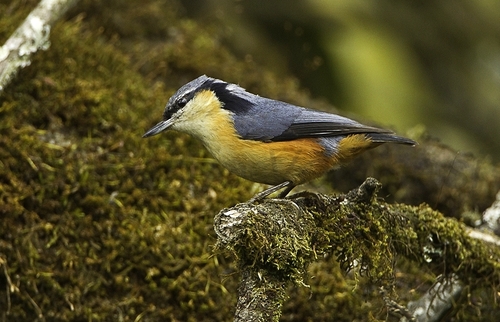
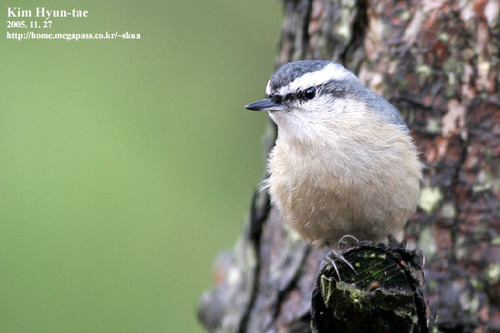
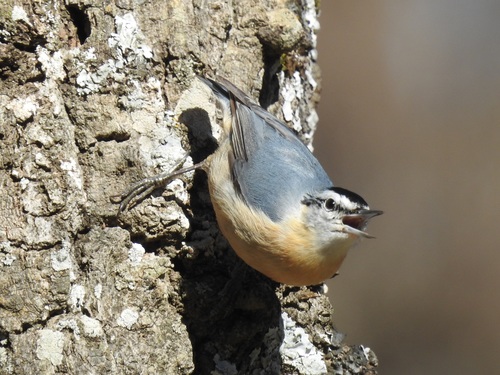
The Algerian nuthatch (Sitta ledanti), also called the Kabyle nuthatch, is a medium-sized nuthatch. It measures 11.5 cm (4.5 in) to 12.5 cm (4.9 in) in length, and weighs approximately 18 grams (0.63 oz). Its upperparts are overall bluish grey; the tail has a small subterminal white band bordered with beige. The belly is lightly tinted light salmon-beige all the way to the undertail coverts, which are grey at their base. Males have a black forehead and a dark eyestripe, separated from the crown by a broad, sharp white supercilium. In females, the crown and eyestripe are the same grey as the back; when plumage is worn, the front of the crown may sometimes be darker, but never as dark as in males. For both sexes, the sides of the head and the throat are white. The irises are brown-black, the legs are lead-grey, and the bill is bluish-grey. Juvenile plumage is similar to that of females, but duller, with an inconspicuous supercilium; after leaving the nest, bill growth and pigmentation of the bill and legs are not complete. Within its range, the Kabyle nuthatch cannot be mistaken for any other bird species. The geographically closest nuthatch is the Eurasian nuthatch (Sitta europaea), which is widespread across Europe and found in some localities in Morocco’s Rif mountains. The Eurasian nuthatch is larger than the Algerian nuthatch, has no black on the crown, and has orange-buff underparts (white in some subspecies) that become orange near the rump. The Kabyle nuthatch strongly resembles the Corsican nuthatch (Sitta whiteheadi), but the black crown of male Algerian nuthatches only covers the front of the head, while male Corsican nuthatches have black across the entire head. Algerian nuthatches also have warmer pinkish buff underparts than Corsican nuthatches. This species is very closely related phylogenetically to Krüper's nuthatch (Sitta krueperi); both have a dark front crown in males and a clearly marked white supercilium, but Krüper's nuthatch has pale grey underparts and a large russet-brown pectoral patch. The Algerian nuthatch is the only bird species endemic to Algeria. It inhabits specific areas of Kabylia, where it has been recorded in five isolated localities separated by deforested areas that are unsuitable for its survival. It was first discovered on Mount Babor, around 20 km² (7.7 sq mi) from the Mediterranean coast. Its optimal habitat covers only 2.5 km² (0.97 sq mi), and a 1985 estimate recorded only 80 breeding pairs in this area. In June 1989, the species was found in Guerrouch within Taza National Park, which hosts a larger population of around 350 individuals. In 1990, smaller populations were discovered in two additional localities near the park: Tamentout and Djimla. In spring 2018, a new breeding site was discovered in Ghabet Ezzen, between the communes of Chahna and Oudjana in Jijel province. On 24 September 2018, two amateur ornithologists, Karim Haddad and Larbi Afoutni, visited the site, and around twenty individuals were observed and photographed in the Lerabaa forest. The species may occur in other oak groves in Petite Kabylie, but these populations have not yet been documented. The Algerian nuthatch lives in oak forests at altitudes between 350 m (1,150 ft) and 1,120 m (3,670 ft), and in mixed forests of oak and Italian maple (Acer opalus subsp. obtusatum), as well as mixed coniferous forests up to the 2,004 m (6,575 ft) summit of Jebel Babor. It prefers humid forests with large trees that provide cavities, and occurs alongside Algerian fir (Abies numidica), Atlas cedar (Cedrus atlantica), aspen (Populus tremula), Afares oak (Quercus afares), cork oak (Quercus suber) and Portuguese oak (Quercus faginea). The Babor Mountains are dominated by fir and cedar forest, and have a cool, humid climate with winter snow up to 4 metres deep that persists until May. In Guerrouch, oaks are dominant and the climate is warmer and drier. At lower altitudes such as Tamentout, forests are dominated by cork oak, and stand densities are lower than at altitudes above 1,000 m (3,300 ft), where this species occurs alongside deciduous oaks such as Algerian oak (Quercus canariensis) and Afares oak. A study conducted on Mount Babor between the summers of 1981 and 1982 found that the factors apparently favourable to the Algerian nuthatch in this massif were "the diversity of tree species, the size (or age) of the trees and indirectly the climate at altitude". The diet of the Algerian nuthatch has not been extensively studied. It changes with the seasons. In summer, it feeds mainly on insects (especially caterpillars and beetles) and spiders, which it finds while foraging on the trunks and branches of oak trees. In winter, when insects are scarce, the Algerian nuthatch feeds on coniferous seeds, which provide a constant food supply. The species generally feeds alone, but may form mixed-species feeding flocks outside of the breeding season.