About Sitta krueperi Pelzeln, 1863
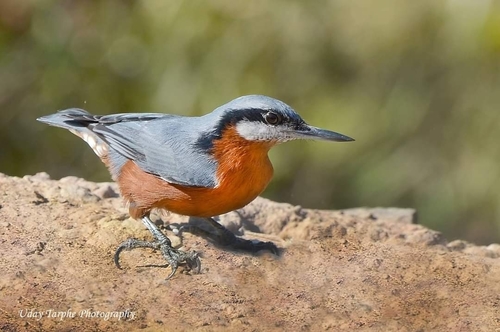
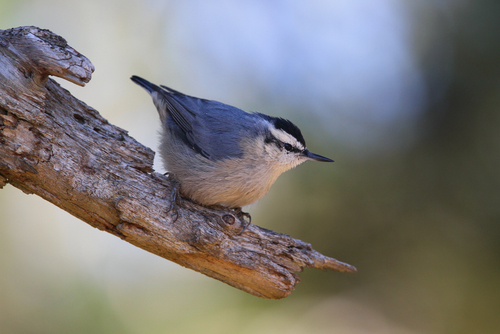
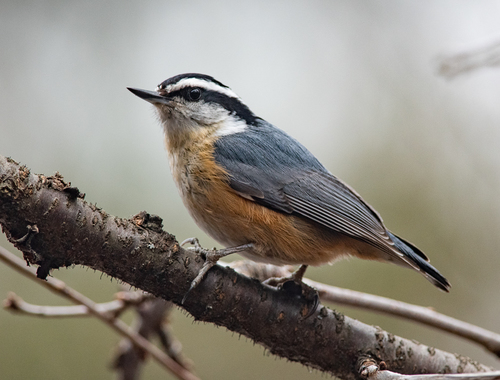
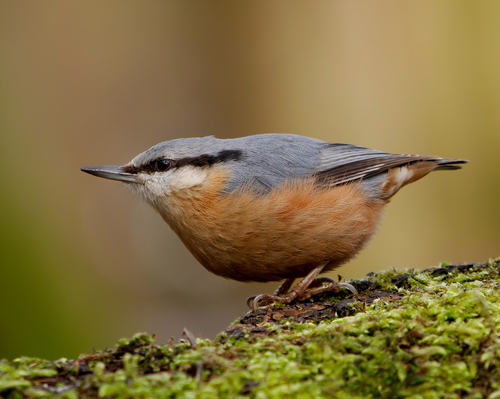
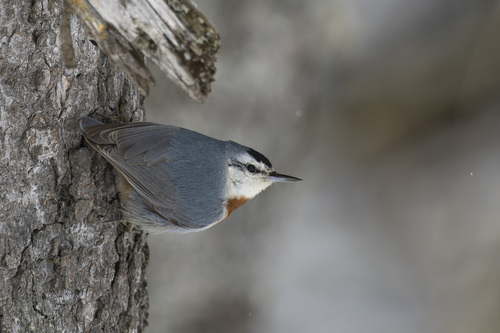
Krüper's nuthatch (Sitta krueperi Pelzeln, 1863) is a small to medium-sized nuthatch that measures 12.5 centimetres (4.9 in) in total length. For body measurements, folded wings are 71–81 millimetres (2.8–3.2 in) in males and 68–74 millimetres (2.7–2.9 in) in females; tails are 33–40 millimetres (1.3–1.6 in) in males and 33–38 millimetres (1.3–1.5 in) in females. Bill length ranges 17.9–20.2 millimetres (0.70–0.80 in), and tarsus length ranges 16.9–19.3 millimetres (0.67–0.76 in). Adult males weigh 10–14.3 grams (0.35–0.50 oz). A study of 41 measurements from many individuals across multiple Turkish localities found only small size variations across the species' range. For adult plumage of both sexes, upperparts are blue-grey with a black patch on the front of the crown, and primary and secondary flight feathers are grey-brown. A white supercilium sits above a less sharply defined black eyestripe that becomes less clear behind the eye. The throat is white, the rest of the underparts are pale grey, and there is a large reddish patch on the crescent-shaped breast. Underwing-coverts are off-white, and undertail feathers are rufous with white tips. The eye is surrounded by a thin white eye ring, the iris is dark cinnamon or brown, the bill is dark horn-grey, the cutting edge of the upper mandible at its base is blue-grey, and the entire base of the lower mandible is also blue-grey. Legs are grey-brown or dark grey. Sexual dimorphism is not very pronounced, especially in summer when plumage becomes worn. Females have a less black crown that is less sharply defined at the back, compared to the male's sharply defined, glossy black crown. Female underparts are paler and buff, while male underparts are blue-grey to pale grey. Juveniles are easier to distinguish, with much duller overall plumage and no black crown; at most, the front of the crown is only darker than the rest of the upperparts. A juvenile's russet pectoral patch is much less marked, as are its supercilium and eyestripe. Juveniles can be told apart from adult females by their fresh plumage, when adult female feathers are worn and their crown is darker. First-year adults sometimes retain some brown coloring on the feather tips of their greater coverts. Adults undergo a full post-nuptial moult from mid-May to early September, and sometimes a partial moult before the March breeding season that particularly affects the chest. There is also a partial post-juvenile moult that involves middle coverts. While the Algerian nuthatch shares Krüper's nuthatch's dark front crown and prominent white supercilium, the Algerian nuthatch has cream or buffy underparts and lacks Krüper's nuthatch's large russet-brown pectoral patch and matching undertail coverts. Both this distinct pectoral patch and the clear difference between adult and juvenile plumage are characteristic of Krüper's nuthatch. Krüper's nuthatch is found almost entirely in Turkey, where it is common in western Anatolia. It also occurs along the Mediterranean coast in the Taurus Mountains, along the Black Sea coast in northern Turkey, and ranges as far east as southern Georgia. It also lives on the Greek island of Lesbos, and is a vagrant to mainland Greece, where one individual was observed in Thessaloniki in October 1955. In 2010, a new nesting area was reported in central Anatolia's Yozgat province, in the Ak Dağları mountains. This site is a pure Scots pine (Pinus sylvestris) forest that may support around 560 individuals. Krüper's nuthatch has a very close association with Turkish pine (Pinus brutia), and the bird's range almost completely overlaps the tree's range. Outlying, mostly small populations of Turkish pine in the Crimea, northwestern Syria, Lebanon, northern Iraq, and Azerbaijan may once have hosted Krüper's nuthatches, or may still hold undiscovered populations of the bird. Krüper's nuthatch is mostly sedentary, but does carry out some dispersal after the breeding season. Seasonal altitudinal shifts have been recorded: some birds, likely first-year individuals, move down from high ground to mixed or deciduous forests in winter. During this season, the species is even commonly observed in the Sochi Arboretum, which hosts many conifers. Krüper's nuthatch inhabits temperate coniferous forests from sea level up to around 2,000 m altitude, and can reach the local tree line at 2,500 m. In Turkey, it mainly occurs between 1,000 m and 1,600 m, and inhabits forests of Turkish pine, Caucasian spruce (Picea orientalis), Caucasian fir (Abies nordmanniana), Cilician fir (Abies cilicica), black pine (Pinus nigra) and Lebanon cedar (Cedrus libani). Recorded population densities are 12.7 individuals per square kilometre in black pine forest, 11.6 in Cilician fir forest, 8.5 in Lebanon cedar forest, and 7.8 in Turkish pine forest. At higher altitudes, it can live among juniper (Juniperus) stands. In the Caucasus, it prefers spruce forests between 1,000 m and 2,000 m, but also occurs in Caucasian fir and pine forests. During the breeding season, Krüper's nuthatch lives alone or in pairs, and pairs stay with their young. In autumn, it is observed in groups of two to five individuals, and sometimes joins mixed-species foraging flocks. Krüper's nuthatch is an active bird that finds food on the smallest branches in the canopies of large trees, but also forages at other vegetation levels, in bushes, and even on the ground. It feeds mainly on insects during the breeding season, and consumes pine and other conifer seeds in autumn and winter when insects are scarce. It gleans insects from branches or catches them in flight, and extracts conifer seeds from cone scales with its bill, then wedges seeds into bark cracks and hammers them open. Krüper's nuthatch also creates food caches to use when moisture closes pine cones and makes seeds inaccessible; the presence of these larders may explain why the bird is territorial even outside the breeding season.