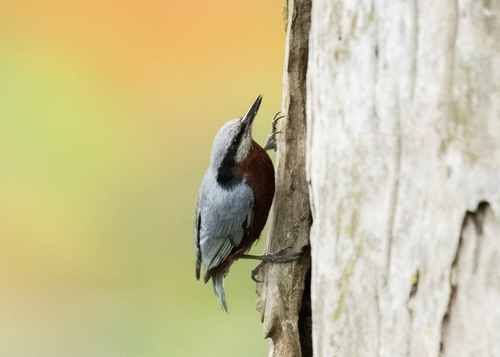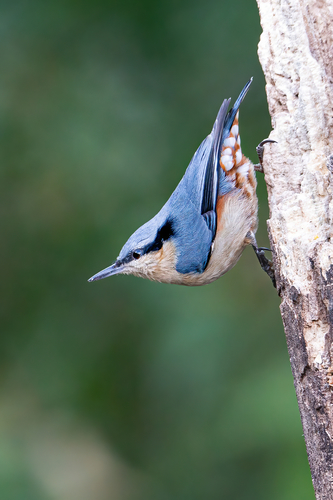
About Sitta himalayensis Jardine & Selby, 1835
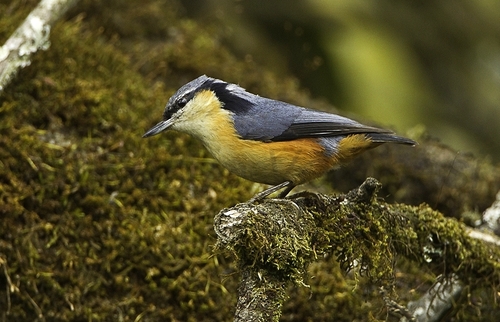
This bird species, Sitta himalayensis Jardine & Selby, 1835, reaches 12 cm in total length, making it slightly smaller than other related Himalayan nuthatches. It can be identified by its buff underside, smaller beak than the Kashmir nuthatch (S. cashmirensis), and paler blue-grey mantle than most related species, with the exception of the Kashmir nuthatch. The white patch located on the centre of the upper tail coverts is difficult to observe in the field. It has a small bill and pale orangey underparts, with unmarked bright rufous undertail-coverts. Its black eyestripe is broader than that of the Kashmir nuthatch, and flares wider behind the eye. This species is resident in the sub-Himalayan range, extending from Himachal Pradesh to Arunachal Pradesh, and continuing into the South Assam Hills (Lushai Hills). It breeds from March to May in broad-leaved and mixed forest. Its natural habitats are subtropical or tropical moist lowland broadleaf forests, and subtropical or tropical moist montane forests. It breeds at altitudes between 1,500 and 3,400 m, and descends to as low as 920 m during winter.