About Sitta frontalis Swainson, 1820
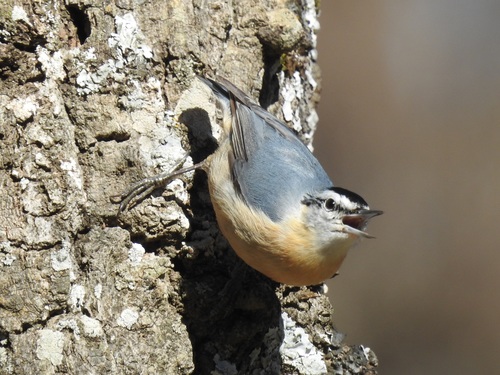
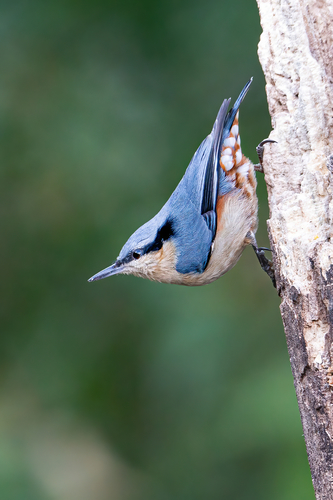
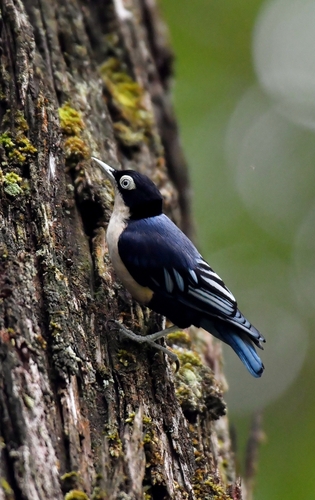
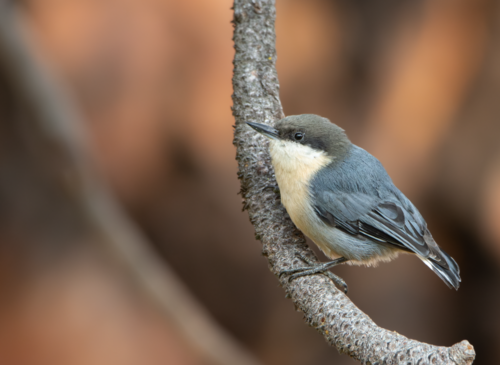
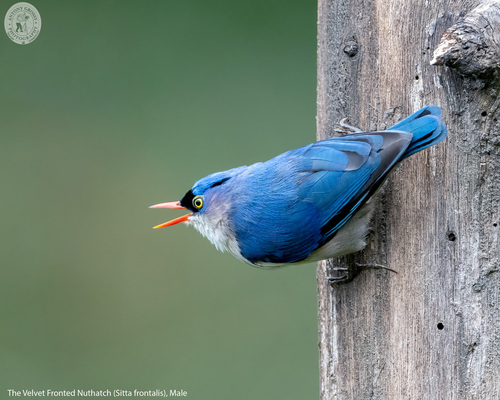
The velvet-fronted nuthatch (Sitta frontalis Swainson, 1820) has the typical shape of a nuthatch, with a short tail and a powerful bill and feet. This is a small nuthatch, measuring 12–13.5 cm in length. Its upperparts are violet-blue, with lavender-colored cheeks, buffy grey underparts, yellow eyes, and a whitish throat. The iris is distinctly pale and yellow. The bill ranges from orange-red to bright red, and adults have a well-developed black patch on the forehead and lores, while younger birds have a less developed patch. Leg color varies between the different subspecies of this species. Young birds have a dark beak and dark tips on their undertail coverts. Adult males can be distinguished by a black superciliary stripe that runs above the eye, over the head, and toward the nape. Females lack this supercilium and have a warmer underpart color. Juveniles are duller versions of adult birds, and do not have the black frontal band. Subspecies differ from each other in shade, size, and how white is distributed across the throat. The velvet-fronted nuthatch is a resident breeder that lives in all types of forest, ranging from deciduous to evergreen forest. In the Sunderbans, it can be found in Sonneratia mangrove forests. It also lives in secondary forest and uses shade trees in coffee plantations in southern India. Like other nuthatches, it has strongly curved claws that allow it to climb down vertical tree trunks, unlike species such as woodpeckers that only move upwards along tree trunks. It moves jerkily up, down, and around tree branches and trunks. It actively feeds on insects and spiders that it gleans from the bark of tree trunks and branches, and can often be found in mixed feeding flocks with other passerine birds. In Sri Lanka, the racket-tailed drongo sometimes catches insects that this nuthatch disturbs. This is a noisy bird, and it is often located by its repeated "sit-sit-sit" call. In northern India, adult velvet-fronted nuthatches undergo a complete postbreeding moult that starts at the end of June. Plasmodium parasites, including Haemoproteus, have been detected in this species' blood. Feather mites belonging to the genus Neodectes are also found on this nuthatch species.