About Sitta europaea Linnaeus, 1758
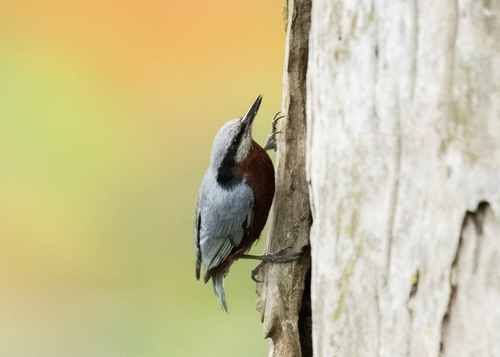
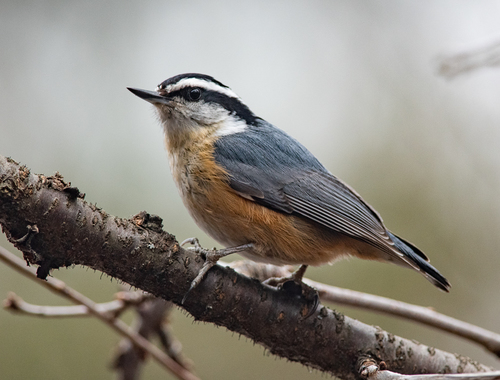
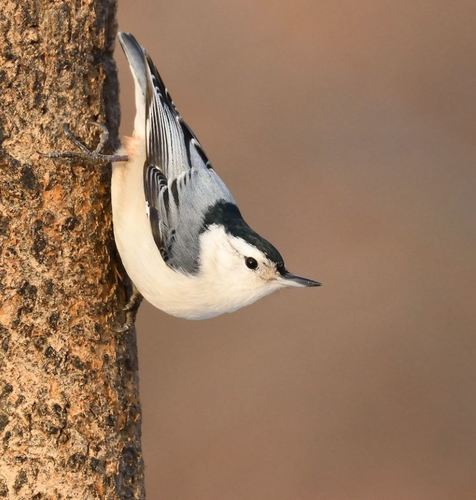
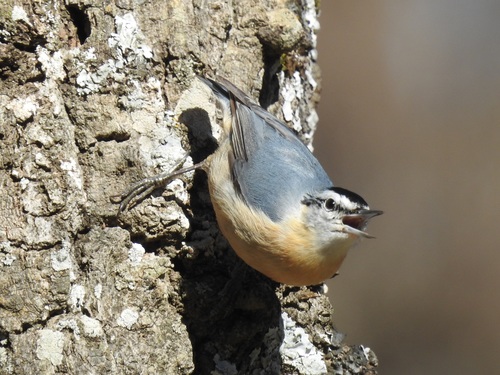
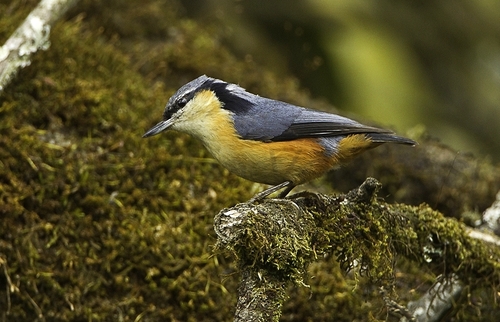
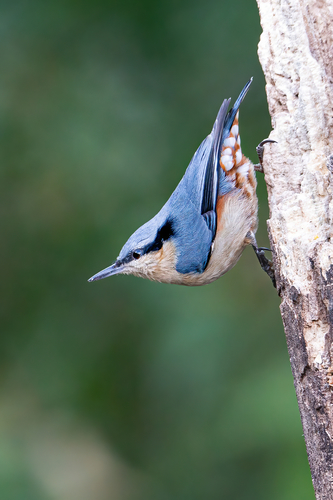
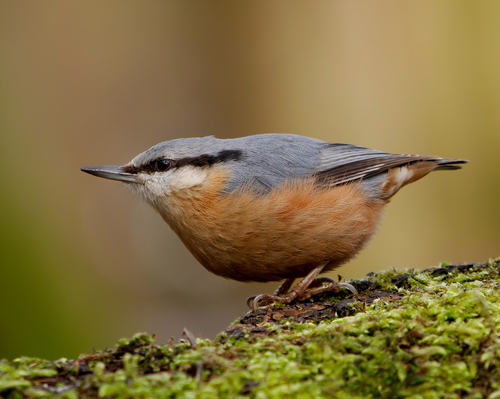
Description: The adult male of the nominate subspecies, Sitta europaea europaea, measures 14 cm (5.5 in) long with a wingspan of 22.5–27 cm (8.9–10.6 in), and weighs 17–28 g (0.6–1 oz). It has blue-grey upperparts, a black eye-stripe, and whitish throat and underparts. The flanks and lower belly are orange-red, and the undertail is mottled with white. Its stout bill is dark grey, with a paler area at the base of the lower mandible; the iris is dark brown, and the legs and feet are pale brown or greyish. Most other subspecies in the S. e. europaea group differ from the nominate form only in small details, most often in the hue of the underparts, but S. e. arctica is quite distinctive. It is large and pale, has a white forehead, a reduced eye-stripe, and more white in the tail and wings than any other subspecies. Nuthatches move along trees with short leaps, and do not use their tails for support. In flight, they have a characteristic appearance: a pointed head, round wings, and a short, square tail. Their flight is fast, with wings closed between beats, and usually lasts only a short time. S. e. caesia, the most widespread western subspecies, has orange-buff underparts, except for a white throat and cheeks. Other western forms differ mainly in the exact shade of the underparts, while some southeastern forms also have a white forehead and supercilium. S. e. sinensis (found in China) and S. e. formosana (found in Taiwan) have buff underparts like western races, but have buff throats instead of white. Females are similar in appearance to males, but can be identified by slightly paler upperparts, a browner eyestripe, and a more washed-out tone on the flanks and lower belly. In the eastern subspecies S. e. asiatica, some males have buff underparts that match the female's coloration, making it difficult to sex these birds in the field. Young birds resemble females, though their plumage is duller and they have paler legs. Individuals can be reliably identified as female from around 12 days old by their paler, buffer flanks, or by the creamier hue of their underparts in some white-breasted subspecies. Adult Eurasian nuthatches undergo a complete moult after breeding that takes approximately 80 days, starting in late May and finishing by late September. The moult period is more compressed for Siberian birds, running from June to mid-September. Fledged juveniles moult some of their wing coverts when they are about eight weeks old.
Distribution and habitat: The Eurasian nuthatch's breeding range extends across temperate Eurasia from Great Britain (but not Ireland) to Japan. It occurs between the 16–20 °C (61–68 °F) July isotherms, reaching north to around latitude 64°N in western Russia and 69°N in Siberia. It breeds south to the Mediterranean in Europe, although it is absent from all Mediterranean islands except Sicily; in most of Russia, the southern breeding boundary lies around 54–55°N. In the east, its range includes most of China, Taiwan, and much of Korea. It has been recorded as a vagrant in Lebanon and the Channel Islands, and the nominate race has been recorded a small number of times in Finland, where S. e. asiatica is the typical native subspecies. Most populations are sedentary, with only limited post-breeding dispersal of young birds, and the species is reluctant to cross even short stretches of open water. Northern and eastern breeding populations depend on the cones of the Siberian stone pine. If the cone crop fails, many S. e. asiatica birds may move west into northern Sweden and Finland in autumn, sometimes remaining to breed there. Siberian S. e. arctica may make more limited movements south and east in winter, and S. e. amurensis from southeast Russia is regularly found in Korea during winter. The species' preferred habitat is mature woodland with large, old trees, which provides plentiful foraging areas and nesting holes. In Europe, it favors deciduous or mixed forest, especially forest that contains oak. It may occupy parks, old orchards, and other wooded habitats as long as these contain at least a 1 ha (2.5 acres) block of suitable trees. Old spruce and pine forests are used particularly in mountains, and pine is also favored in Taiwan. In most of Russia, conifers are used for nesting, but population densities are relatively low. Moroccan birds nest in oak, Atlas cedar, and fir. Uncommon habitats used by the species include dwarf juniper in Mongolia and rocky terrain in a limited area of southern Siberia. In the north of its range, the Eurasian nuthatch is primarily a lowland bird. It reaches the tree-line in Switzerland, at 1,200 m (3,900 ft) or higher, and breeds occasionally at 1,800–2,100 m (5,900–6,900 ft) in Austria. It breeds at similar elevations in the mountains of Turkey, the Middle East, and Central Asia. It is mainly a mountain bird in southern Japan, found between 760–2,100 m (2,490–6,890 ft), and in Taiwan, found between 800–3,300 m (2,600–10,800 ft). In southern China, the chestnut-vented nuthatch occupies highland areas, so the Eurasian nuthatch occurs at lower elevations here.