About Sitta cinnamoventris Blyth, 1842
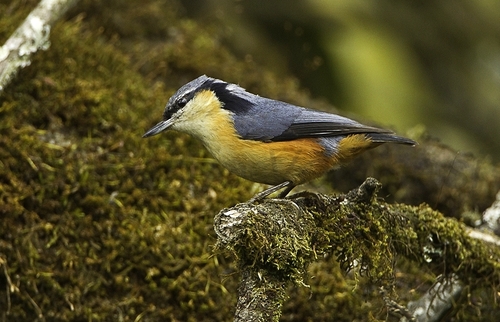
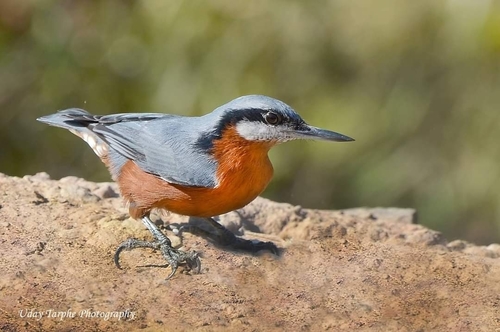
The chestnut-bellied nuthatch, with the scientific name Sitta cinnamoventris, is a bird species that belongs to the family Sittidae. It occurs in the Indian subcontinent, where it can be found in the countries and regions of India, Tibet, Bangladesh, Bhutan, and Nepal. This species lives in subtropical or tropical dry forests, subtropical or tropical moist forests, as well as both montane and lowland forests. It is very similar in appearance to the Burmese nuthatch, but it has a heavier bill, and its crown and mantle are the same shade. Its wing and tail markings have distinct contrasts: the primaries have silvery edges, while the inner webs of the tertials and tail are blackish, and the tail bears large white spots. In 2005, Rasmussen and Anderton established that the chestnut-bellied nuthatch is a distinct species separate from both the Indian nuthatch and the Burmese nuthatch. Unlike the Indian nuthatch, the white coloring on the chestnut-bellied nuthatch’s ear coverts does not extend into the chin. Two subspecies are recognized: the race almorae, found in Nepal and the northwest Himalayas, which has paler underparts; and the race koelzi, found in the eastern Himalayas, in which females are darker than females of other races. This is a resident species with a range extending from the Murree Hills to the Uttaranchal foothills, and continuing through the Assam Valley and Arunachal Pradesh into the Lushai Hills.