About Sitta carolinensis Latham, 1790
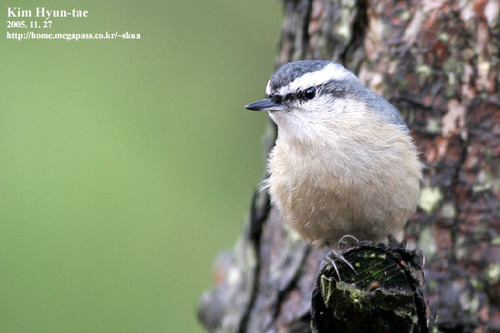
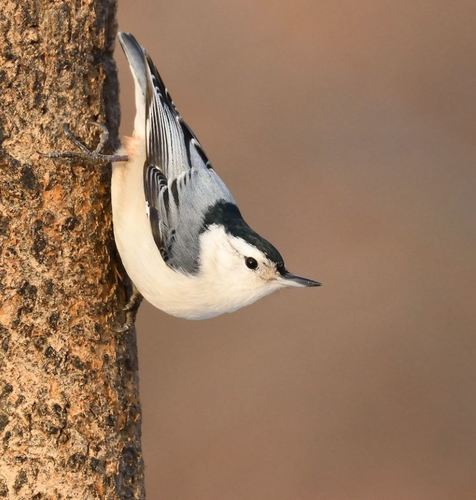
The white-breasted nuthatch (Sitta carolinensis) is a medium-sized nuthatch. Most sources note it measures about 15.5 cm (6.1 in) in length, while other sources cite a length range of 13–14 cm (5.1–5.5 in), a wingspan of 20–27 cm (7.9–10.6 in), and a weight of 18–30 g (0.63–1.06 oz). Like other members of its genus, it has a large head, short tail, short wings, a powerful bill, and strong feet. For the adult male of the nominate subspecies S. c. carolinensis, upperparts are pale blue-gray, with a glossy black cap on the crown of the head and a black band on the upper back. Wing coverts and flight feathers are very dark gray with paler fringes; a closed wing is pale gray and black, with a thin white wing bar. The face and underparts are white. Outer tail feathers are black, with broad diagonal white bands across the outer three feathers, a feature that is easy to see when the bird is in flight. Compared to the adult male, the average adult female has a narrower black back band, slightly duller upperparts, and buffer underparts. A female’s cap may be gray, but many females have black caps and cannot be reliably told apart from males in the field. In the northeastern United States, at least 10% of females have black caps; this proportion rises to 40–80% in the Rocky Mountains, Mexico, and the southeastern United States. Juveniles are similar to adults, but have duller plumage. Three other smaller nuthatch species have overlapping ranges with the white-breasted nuthatch, but none have white plumage that completely surrounds the eye. Additional distinguishing marks: the red-breasted nuthatch has a black eye line and reddish underparts, while the brown-headed and pygmy nuthatches each have a brown cap and a white patch on the nape of the neck. Currently, seven subspecies of the white-breasted nuthatch are accepted, though their differences are small and change gradually across the species’ range. Subspecies are grouped into two to four clusters based on similarities in morphology, habitat use, and vocalizations, with groups covering eastern North America, the Great Basin and central Mexico, and the Pacific coastal regions. In 2013, a proposal was submitted to the American Ornithologists Union to split these groups into two, three, or four separate species. The proposal was not approved due to insufficient evidence, but the species’ status is expected to be reevaluated when more evidence becomes available. Subspecies from the western interior have the darkest upperparts and a narrower dark crown above white cheeks. The eastern nominate subspecies S. c. carolinensis has the palest back and a broader dark crown above the cheeks. The eastern form also has a thicker bill than interior and Pacific subspecies. Calls differ between the three main groups. A 2017 study examined and revised the previously accepted subspecies boundaries within California. The white-breasted nuthatch’s breeding habitat is woodland across North America, ranging from southern Canada to northern Florida and southern Mexico. In the eastern portion of its range, it prefers old-growth open deciduous or mixed forest, and also occurs in orchards, parks, suburban gardens, and cemeteries. It is found mainly in lowlands here, though it breeds at up to 1,675 m (5,495 ft) elevation in Tennessee. In the western United States and Mexico, it occurs in open montane pine-oak woodlands, and nests at up to 3,200 m (10,500 ft) elevation in Nevada, California, and Mexico. Pinyon-juniper and riverside woodlands may be used locally when available. The white-breasted nuthatch is the only North American nuthatch usually found in deciduous trees; red-breasted, pygmy, and brown-headed nuthatches prefer pines or other conifers. The presence of mature or decaying trees with holes suitable for nesting is required for this species; oak, beech, and hickory are favored in the east because they also provide edible seeds. Unlike red-breasted nuthatches, white-breasted nuthatches rarely excavate their own nest holes. Although suitable habitat is spread across the North American continent, it is not continuous. As a non-migratory species, separated populations have diverged to form distinct regional subspecies. Like most members of its genus, the white-breasted nuthatch is non-migratory, and adults normally remain in their territory year-round. Some years may bring more noticeable dispersal in response to seed crop failure or high reproductive success. This species has appeared as a vagrant on Vancouver Island, Santa Cruz Island, and Bermuda. One individual landed on the RMS Queen Mary in October 1963, when the ship was six hours sailing east of New York City. In winter, the white-breasted nuthatch often travels in small mixed-species foraging flocks. These flocks are led by titmice and chickadees, with nuthatches and downy woodpeckers as common accompanying species. Flock participants are thought to gain benefits for foraging and predator avoidance. Accompanying species likely use information from chickadees’ calls, which allows them to reduce their own predator vigilance.