About Sitta azurea Lesson, 1830
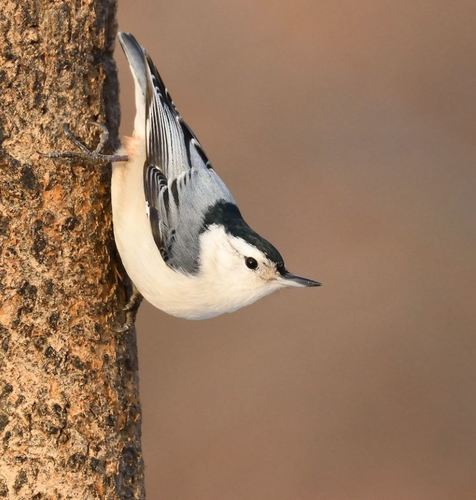
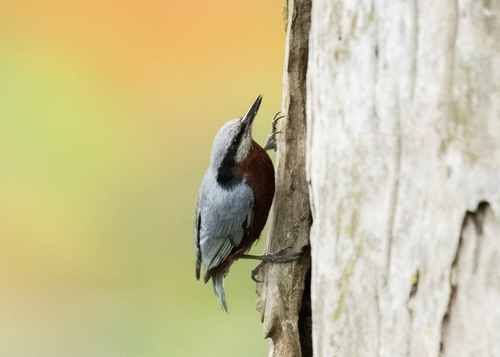
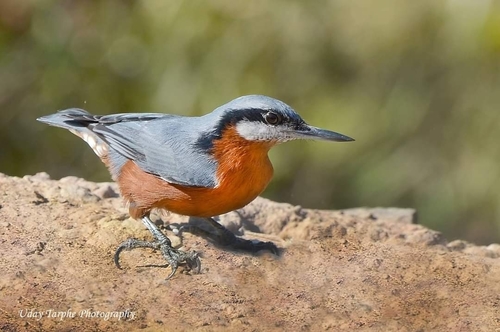
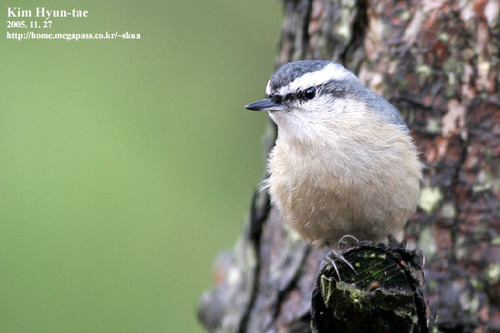
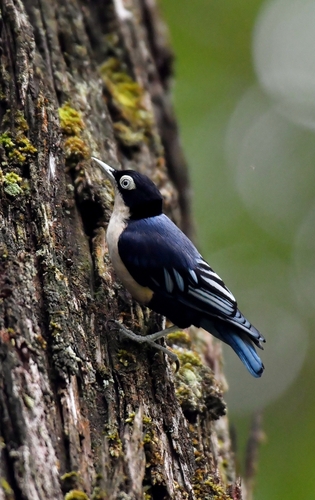
The blue nuthatch (Sitta azurea Lesson, 1830) is a medium-sized nuthatch with an average length of 13.5 cm (5.3 in); its weight has not been recorded. Its appearance differs noticeably from all other nuthatch species. All of its subspecies are broadly black and white, especially when viewed in low light where their dark blue color is not visible. Their upper plumage has distinct shades of cobalt, azure, other lighter blues, greys, and purples. The head is black or blackish-blue with a broad, pale blue eye ring. The three recognized subspecies differ in the color of their mantle, chest, and belly. Across subspecies, upperparts are either dark blue at the mantle or purplish. The tail feathers are pale blue in the center with a black border, and contrast sharply with the darker areas of the bird's plumage. The throat and breast are white, or have a buff wash, which is especially prominent in the subspecies S. a. nigriventer. The belly and abdomen are blackish, contrasting with blue-grey or purplish underwing coverts. The bill is lavender with a faint green tinge and is black at the tip; legs are pale blue-grey, and claws are slate-grey or black. The species does not show significant sexual dimorphism, though Japanese ornithologist Nagamichi Kuroda notes that female blue nuthatches have slightly duller upperparts. Juvenile blue nuthatches resemble adults, but have duller crowns and ear coverts, plus an overall brown tint that does not cover their entire body. The juvenile belly is dull black, and undertail coverts have variable creamy white edges. Juvenile bills are blackish with a pink base. Adults undergo a partial moult before breeding season: this occurs February–March for S. a. expectata, and March–April for S. a. azurea, and only affects the throat, chest, and mantle. A complete full moult happens after breeding season, taking place from March–April and August in Java and Malaysia. This species is distributed across the Malay Peninsula (extreme southern Thailand and northern Malaysia), and the Indonesian islands of Sumatra and Java. In Malaysia, it has been recorded in Bukit Larut (Perak), the Titiwangsa Mountains, and southern Hulu Langat (Selangor). Isolated populations also exist on the slopes of Mount Benom (Pahang), Mount Tahan (on the Pahang-Kelantan border), Mount Rabong (Kelantan), and Mount Padang (Terengganu). In Sumatra, the blue nuthatch occurs throughout the Barisan Mountains, and has been observed in the Gayo Highlands (Aceh province), the Batak Highlands (northern Sumatra), and Dempo in the southern part of the island. During a 1918 expedition, Robinson and Kloss reported that this brightly colored small nuthatch was very common from the start of dense jungle on valley slopes up to around 8,000 feet on Korinchi Peak, where it fed on tall tree trunks in groups of six to seven. Blue nuthatches typically inhabit mountainous areas, living in subtropical or tropical moist lowland forest and subtropical or tropical moist montane forest. In Malaysia, it occurs between 1,070 m (3,510 ft) and 2,186 m (7,172 ft) (the highest elevation in the country). In Sumatra, its recorded altitudinal range is 900 m (3,000 ft) to 2,400 m (7,900 ft); on Java, this range is 915 m (3,002 ft) to 2,745 m (9,006 ft). It is occasionally seen at lower altitudes on the plains of Java. In terms of behaviour and ecology, the blue nuthatch is very active. It is most often seen running along tree branches alone, in pairs, in larger groups, or mixing with mixed-species foraging flocks.