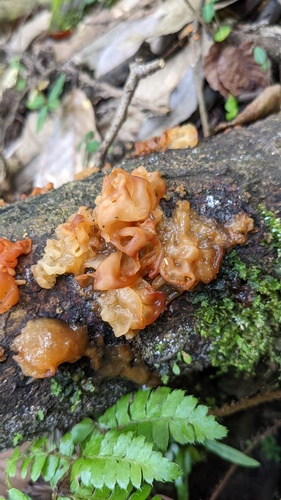
About Sirobasidium magnum Boedijn
The scientific name of this fungus is Sirobasidium magnum Boedijn. Its fruit bodies are gelatinous, lobed, and folded, with an orange-brown color, and can measure up to 45 mm across. Basidia of this species are catenulate, meaning they form in chains, with up to 8 basidia per chain. Individual basidia range in shape from oval to fusiform, and are 2-4 transversely septate. Sterigmata are deciduous, fusiform, and measure 15-19 by 4-5 μm. Basidiospores are globose, and measure 7-9 μm across. Sirobasidium magnum was originally described growing on rotten wood, but it may be parasitic on fungi from the genus Hypoxylon that grow on dead attached or fallen wood. This species has been recorded in Asia (including China, Indonesia, Japan, Korea, Malaysia, Philippines, Singapore, Taiwan, Thailand), Australia, the Seychelles, Tahiti, and North America (the USA).

