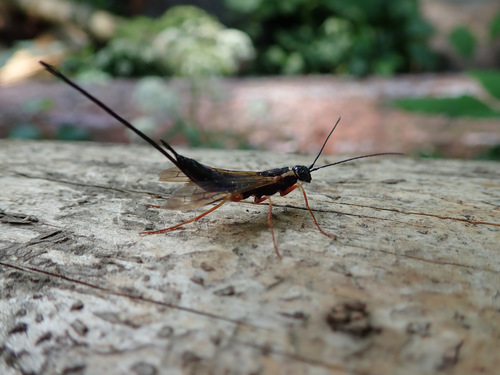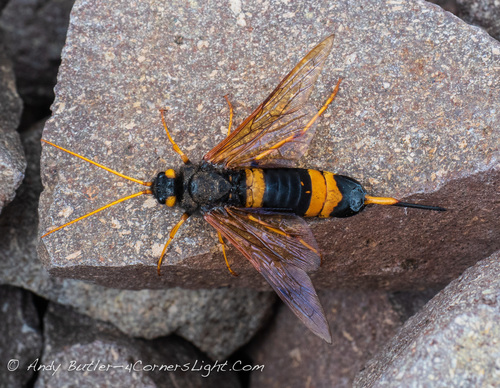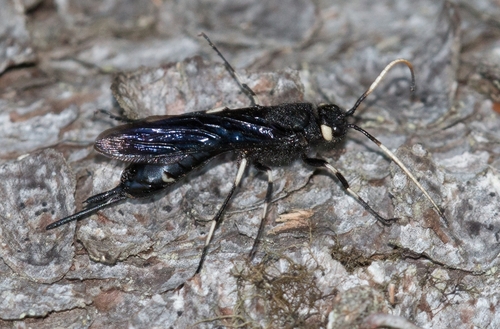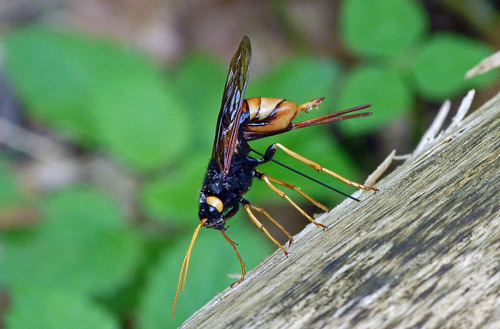
About Sirex noctilio Fabricius, 1773
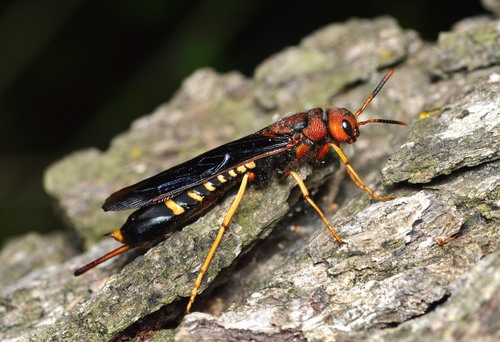
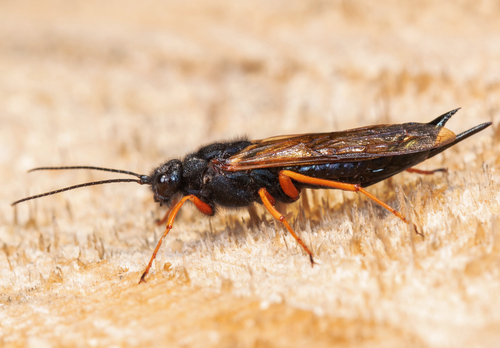
Sirex noctilio, commonly called the Midnight woodwasp, European woodwasp, European horntail woodwasp, or sirex woodwasp, is a species of woodwasp native to Europe, Asia, and northern Africa. Adult individuals range in length from 9 to 36 mm (3⁄8 to 1+3⁄8 inches). This woodwasp is an invasive species in many regions across the globe, including Australia, New Zealand, North America, South America, and South Africa, where it has become a major economically harmful pest of pine trees. It can attack a wide range of pine species, with some species being more susceptible than others, and it most often attacks stressed trees. During oviposition, the female wasp lays eggs alongside a mucoid substance and a symbiotic fungus that provides food for hatching larvae. The mucoid substance is toxic to pine trees and contributes to tree decline. Arthrospores from its symbiotic fungus, Amylostereum areolatum, are also pathogenic to host trees. The native range of the European woodwasp falls within the temperate Palearctic realm, stretching from the Maghreb region of northwest Africa, across all of Europe, and through Siberia, Mongolia, and into the Kamchatka Peninsula in Asia. It naturally inhabits dense, pine-rich forests. The species has spread to other continents including Australia, South Africa, and North America via international exports of timber and firewood. While invasion was prevented in North America for a long time, the species became established in New Zealand around 1900, where it caused massive pine tree declines during the first half of the 20th century. It spread to Tasmania in the 1950s, and later reached the Australian mainland. Since 1980, it has invaded pine plantations in Uruguay, then spread to Argentina, Brazil, and Chile; it was first recorded in South Africa in 1994. Populations in the Great Lakes region of North America began increasing in 2004, and by 2009 the species had spread to Vermont, New York, Pennsylvania, Ohio, and Michigan. Adult European woodwasps can swarm 20–50 km (12–31 mi), and current spread rates predict the species will reach the far southeast of the United States by approximately 2050. In response, forestry authorities have intensified pest control efforts and launched public education campaigns warning against transporting firewood over long distances or storing it for extended periods. Additional spread via timber export has brought the wasp to East Asia, Western Australia, and parts of Africa. Remote regions like the Horn of Africa may remain free of the species if effective biosecurity control is maintained. The Invasive Species Specialist Group (ISSG) of the IUCN has classified this wasp as heavily invasive. Adult (imago) flight season begins in late summer to early autumn, with exact timing varying by region and local climate. Males hatch earlier than females and form swarms that congregate around treetops. Females move to these mating leks and mate with males on the uppermost tree shoots. After mating, females search for suitable host trees, preferentially selecting weak, dry wood. They orient to host trees by detecting monoterpene hydrocarbon compounds, which are released by weakened trees. When a tree is stressed by drought or external injury, these compounds permeate osmotic barriers and escape through the tree bark. The female lands on the bark and drills multiple holes through the wood into the xylem, placing one egg in each hole. At the same time, she inserts spores of Amylostereum areolatum and a phytotoxic mucoid secretion into each hole. Drilled holes branch into multiple radial tubes extending away from the original entry point. Eggs are white, sausage-shaped, and measure 1.0–1.5 mm (5⁄128–1⁄16 in) by 0.2–0.3 mm (1⁄128–1⁄64 in). Small females may lay as few as 20 eggs total, while the largest females can lay up to 500 eggs. Eggs are not always deposited in every drilled tube; the female will often inject only secretion and fungal spores into the last tube she drills. Females typically die just three or four days after starting oviposition, and sometimes even die during the egg-laying process from overexertion.