About Siren lacertina Österdam, 1766
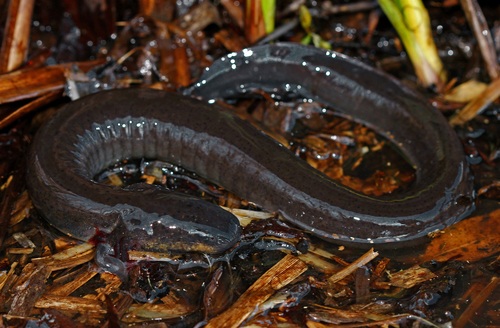
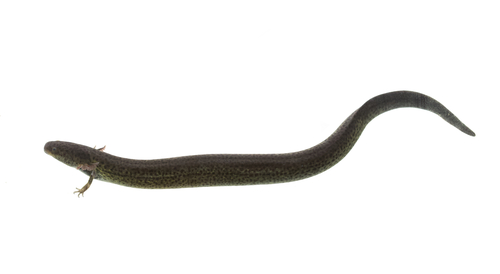
The greater siren, scientifically named Siren lacertina, is the third longest salamander found in the Western Hemisphere. Like all sirens, S. lacertina is paedomorphic. This species lacks both hindlimbs and a pelvic girdle, retains external gills throughout its entire life, and also has small lungs. It does not have eyelids, and its pectoral girdle remains unfused. Upon hatching, greater sirens measure around 1.5 cm (0.59 in) long. As adults, they reach total lengths between 18 and 97 cm (7 to 38 in), and their weight ranges from 55 to 1,000 g (1.9 to 35.3 oz). Their coloration varies across their range, but they are typically olive or gray with small yellow or green dots along their sides. They have between 36 and 40 costal grooves between the armpit and cloaca regions. Young greater sirens have a distinct light stripe along their sides that fades as they age. Their small front legs, each bearing four toes, are tiny enough to be hidden within the external gills. For sensing their environment, greater sirens rely more on a modified Jacobson's organ and a lateral line system than on their small eyes. It is possible they can sense electrical field disturbances, through dense clusters of neuromasts located on their heads. Greater sirens inhabit the coastal plain stretching from Washington, D.C., to Florida and Alabama. A population of sirens in the Rio Grande around Texas and Tamaulipas, Mexico was tentatively classified as S. lacertina, but recent studies have rejected this classification. These salamanders live in wetlands, and prefer wetlands with slow or no current and a thick layer of organic material. Thanks to their ability to aestivate, they can live in both seasonal and permanent wetlands. If their wetland dries out, they burrow into mud. They are mostly found in the deep benthic zone, where aquatic insects are most abundant. Additional habitats they occupy include vegetative ditches and other slow or stagnant bodies of water. During the day, they seek shelter from predators under logs and other submerged structures. Greater sirens act as midlevel predators and fill a critical role in aquatic food webs. They swallow molluscs whole and expel the shells as waste. They are nocturnal, and spend daylight hours resting in dense vegetation. When moving underwater, S. lacertina uses a bipedal-undulatory gait, which combines two-legged movement with side-to-side swaying of the body. Their lifespan in the wild has not been documented, but greater sirens can live up to 25 years in captivity. They are capable of vocalizing, producing clicks or yelps that sound similar to the call of the American green tree frog. If necessary, they can aestivate for multiple years. When aestivating, they burrow into mud and secrete a cocoon made of dead skin cells. This behavior has been observed during droughts and hydroperiod fluctuations, and large individuals with high lipid content can remain in aestivation for up to three years. They perform trimodal respiration, with gas exchange taking place across three surfaces: the gills, the skin, and the lungs. Confirmed predators of the greater siren include the American alligator and the mud snake. Other predators of this species are not well documented. However, on June 19, 2008, a two-toed amphiuma was observed consuming a greater siren, indicating that two-toed amphiumas may be an additional predator of this species.