About Siren intermedia Barnes, 1826
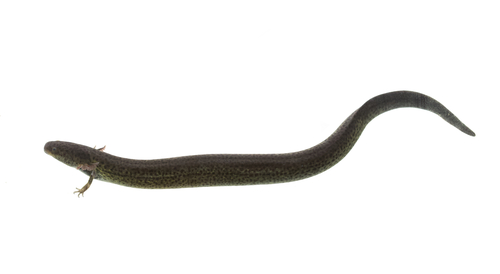
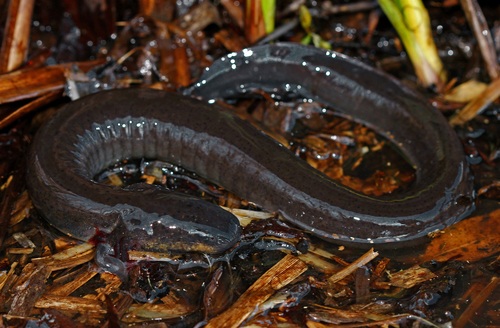
Description: Lesser sirens (Siren intermedia) have elongated bodies with only two limbs, a pair of four-toed legs positioned behind the base of the head. Their total length ranges from 7 to 27 inches, which equals 17 to 69 cm. Unlike greater sirens, lesser sirens have fewer than 35 costal grooves. While closely related juvenile siren specimens have red to yellow banding on the head and stripes running along the full length of the body, these stripes are not present in Siren intermedia. Adult Siren intermedia have plainer body coloration: the dorsal side is typically olive green to blue-gray or black, and the ventral side is usually light gray. Spotted patterns may also appear on adult individuals. For most salamander species, sexual size dimorphism is usually female-biased, but this is reversed in Siren intermedia. In this species, males are the larger sex, and they also have significantly larger heads and enlarged masseter muscles than females. Notably, lesser sirens are neotenic, and retain external gills throughout their entire lives. Habitat: Sirens are most often found in ponds near other intermittent wetlands. They usually live in swamps and ponds, and can survive in dry ponds for up to two years by entering aestivation. Sirens are considered poor overland dispersers, because they rarely leave the water. As a result, their geographical distribution is largely shaped by pond connectivity and biotic interactions. Lesser sirens are fully aquatic salamanders, but their ability to tolerate dehydration allows them to have strong survival rates in their ephemeral habitats. During aestivation, sirens can osmoregulate and produce a mucoid cocoon, which greatly reduces dehydration and electrolyte stress. Their small legs let them move across dry land for short periods of time. Geographic distribution and ecology: The lesser siren is found in the United States and Mexico. Its primary range extends from Virginia to Florida, west to Texas, reaches into northeastern Mexico as far as Veracruz, and extends north to Illinois and southwest Michigan. Multiple specimens were recently rediscovered in Michigan after a 60-year absence from that state's recorded populations. Unlike many other salamander and frog species that can occupy a range of dry and wet habitats, lesser sirens only occur in permanent wetlands. In these permanent wetlands, lesser sirens are top predators. They can quickly colonize new ponds, such as those constructed by beavers, and become the dominant consumer species in these habitats. Their ability to aestivate, burrow in soft sediments, and live in dense aquatic vegetation in shallow waters helps them achieve this dominance. Additionally, the species has high productivity, high fecundity, and rapid growth that leads to early sexual maturity, which allows it to quickly and easily reach a high population density, and establish dominance in its habitat.