About Siproeta stelenes Linnaeus, 1758
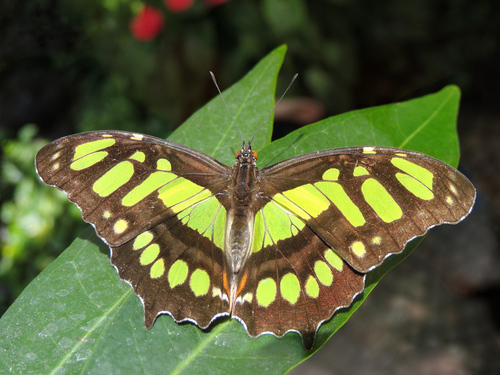
Siproeta stelenes, commonly called the malachite, is a Neotropical brush-footed butterfly that belongs to the family Nymphalidae. This butterfly has large wings: the upperside is black and bright brilliant green or yellow-green, while the underside is light brown and olive green. It gets its common name from the mineral malachite, which shares a similar color with the bright green markings on the butterfly's wings. The typical wingspread of the malachite butterfly ranges from 8.5 to 10 centimeters, which equals 3.3 to 3.9 inches. The malachite is found across Central America and northern South America, where it is one of the most common butterfly species. Its distribution reaches as far north as southern Texas and the tip of Florida, extends to Cuba where the subspecies S. s. insularis (Holland, 1916) and S. s. biplagiata occur, and reaches south to Brazil. Adult malachites feed on flower nectar, rotting fruit, dead animals, and bat dung. Females lay their eggs on the new leaves of plants in the family Acanthaceae, particularly species in the genus Ruellia. The larvae are horned, spiny black caterpillars marked with red. The pupal stage is green, with sharp gold spines that are capable of puncturing predators. Malachite butterflies are often confused with Philaethria dido, a member of heliconiine butterflies. While the two species have similar coloration, their wing shapes differ.