About Siphonops annulatus (Mikan, 1822)
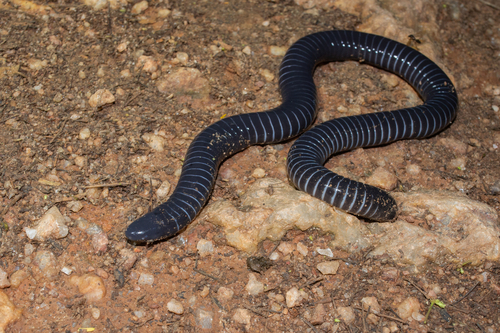
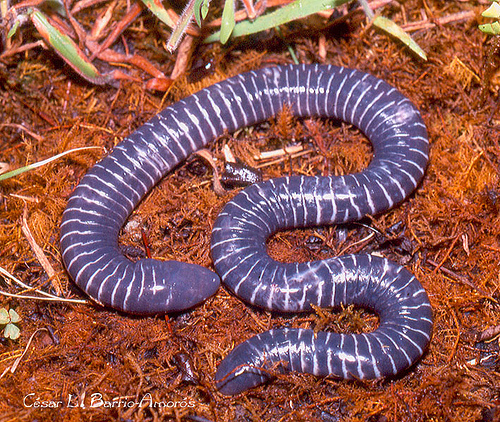
Siphonops annulatus, commonly called the ringed caecilian, has a total length ranging from 286 to 450 mm (11.3 to 17.7 in). Its body is cylindrical, and is slightly wider than it is deep. The species ranges in colour from bluish-black to slate. The annular grooves that completely encircle its body (with the exception of the 3 to 4 posteriormost grooves) are edged in white or cream. A team of scientists from Brazil and the United States found that this species has skin glands with different specialized functions. Glands on the head excrete lubricating mucus that may aid the caecilian in burrowing, while glands on the tail region contain noxious chemicals, similar to the poison glands found in other amphibians such as toads and newts. The ringed caecilian is widely distributed east of the Andes. It was originally discovered in Brazil, and has also been reported in Argentina, Bolivia, Colombia, Ecuador, French Guiana, Guyana, Paraguay, Peru, Suriname, and Venezuela. Its natural habitats include subtropical or tropical moist lowland forest, dry savanna, moist savanna, subtropical or tropical moist shrubland, subtropical or tropical seasonally wet or flooded lowland grassland, pastureland, plantations, rural gardens, and heavily degraded former forest. For this species, mating takes place between the end of August and the beginning of October, and oviposition occurs between November and December. Nestlings have 44 spoon-shaped teeth that they use to feed on the outer layer of their mother's skin. All young feed at the same time for around seven minutes, then all rest for three days while the female grows a new outer skin layer. This behavior is called maternal dermatophagy. This practice, along with shared morphological similarities, is also seen in the African relative Boulengerula taitana, which suggests this trait evolved over 100 million years ago. As detailed in a 2024 study, researchers collected 16 maternal ringed caecilians from cacao plantations in Brazil's Atlantic Forest and filmed them with their altricial hatchlings in a laboratory setting. The mothers stayed with their offspring, which suckled a white, viscous liquid from the mothers' cloaca. The hatchlings experienced rapid growth during their first week. This milk-like substance, which is rich in fats and carbohydrates, is produced by hypertrophied glands in the mother's oviduct epithelium, similar to how mammal milk is produced. The substance appears to be released in response to tactile and acoustic stimulation from the baby caecilians. Researchers observed hatchlings emitting high-pitched clicking sounds as they approached their mothers to feed, a behavior that is unique among amphibians. This milk-feeding behavior may support the development of hatchlings' microbiome and immune system, similar to the effect seen in mammalian young. The presence of milk production in egg-laying caecilians suggests an evolutionary transition between egg-laying and live birth.