About Siphanta acuta (Walker, 1851)
Scientific name: Siphanta acuta (Walker, 1851)
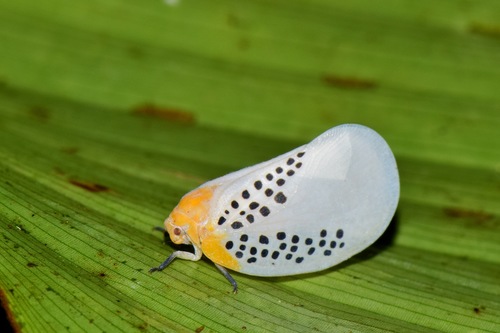
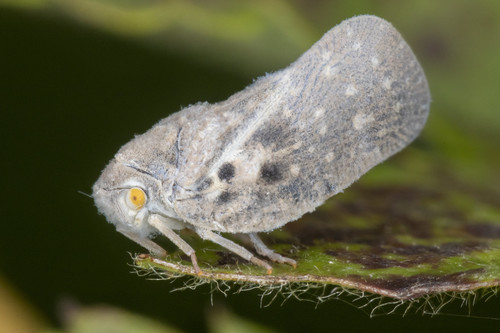
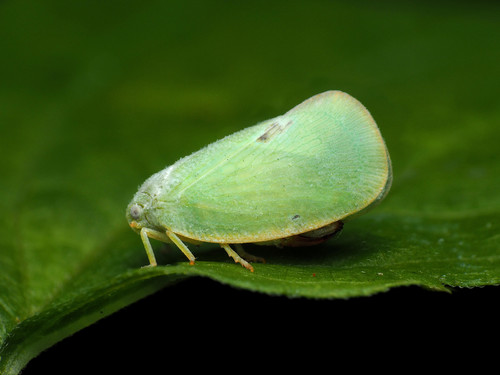
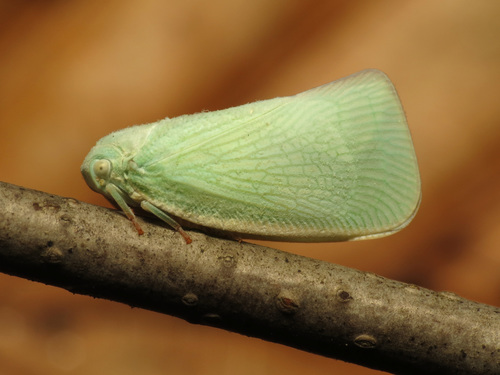
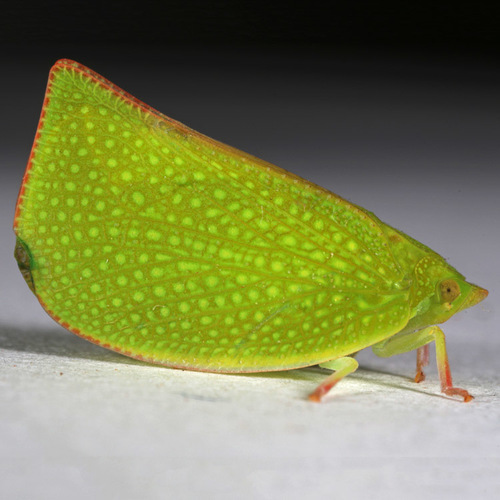
Adult Siphanta acuta, like other members of the Flatidae family, have large wings and a bright green body. Their wings are triangular, sharply pointed at the tip, and held in a steep roof-like position over the body. The wings extend past the end of the abdomen and almost reach the ground, concealing most of the insect’s body. Only a pointed head, the distal segments of the front and middle legs, and sometimes the tarsus of the hind legs are visible. Mature green planthoppers reach an average body length of around 9.3 mm. They have two pairs of wings, three pairs of legs, one pair of antennae, and compound eyes on either side of the head. They also have piercing-sucking mouthparts, and females have an ovipositor at the end of the abdomen.
Nymphs of Siphanta acuta are white. They have a pair of waxy filaments on either side of the sixth abdominal segment, plus two long waxy tufts at the tip of the abdomen. Their overall body shape matches the adult form, and they have a rostrum for feeding, three pairs of legs, and one pair of antennae.
Siphanta acuta is native to Australia, where it occurs across the continent and in Tasmania. It has been introduced adventively to California, Hawaii, and South Africa. In New Zealand, it is found on both the North and South Islands. Recorded distributions on the North Island include Auckland, Bay of Plenty, Coromandel, Gisborne, Hawkes Bay, Northland, Taranaki, Wairarapa, Wanganui, Wellington, and Waikato. Recorded distributions on the South Island include Buller, Central Otago, Mid Canterbury, Nelson, and Westland.
This species prefers lowland, often coastal, and montane habitats. Individuals have been recorded in a wide range of environments, including gardens with native and introduced plants, broadleaf and mixed forests, and moss growing on rocks at high altitude. Common host plants in New Zealand are Coprosma, citrus trees, and a variety of ornamental shrubs. In Australia, it feeds on a wide range of native and exotic plants. Younger nymph instars are typically found on leaves, while older instars are usually found on stems, which reflects differences in food preference. Siphanta acuta in the North Island of New Zealand favor citrus, while populations in Nelson prefer ornamental shrubs.
Adult Siphanta acuta are most commonly encountered during summer and autumn. After mating, females use their ovipositor to lay 90 to 110 eggs in a flat oval cluster called an egg-cushion on the surface of a leaf. Egg-cushions turn from white to black as a fungus grows on the empty egg shells after hatching. Newly hatched first instar nymphs stay near their egg mass for the early part of their life. Siphanta acuta grows through five instar stages by molting. Second and third instars gradually turn green, reaching a length of 3.6 mm by the third instar. Fourth instars develop small reddish marks, while fifth instars are white with pink markings.