About Sinotaia quadrata (W.H.Benson, 1842)
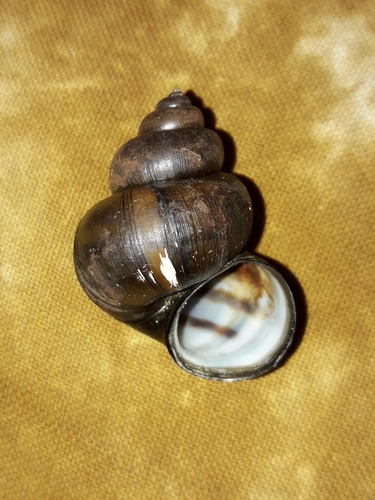
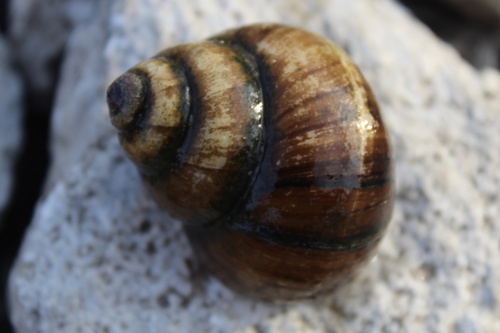
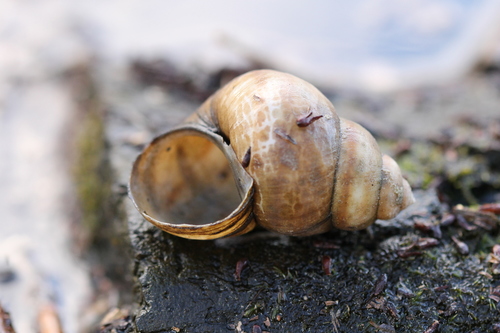
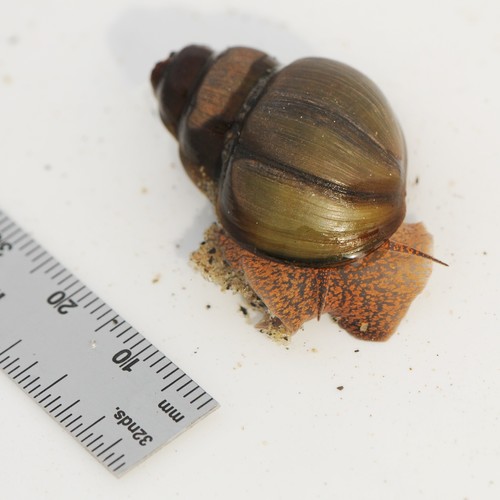
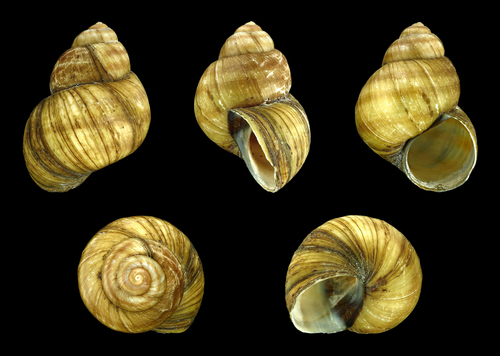
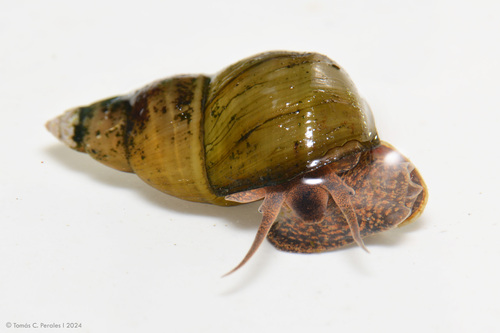
Sinotaia quadrata is a gill-breathing freshwater snail species, where males have a thickened right tentacle, while females do not. By dry weight, the average tissue composition of this species is 28.6% foot, 23.06% intestine, 9.78% gonad, 8.58% hepatopancreas, and 29.98% other tissue. The diploid chromosome number of Sinotaia quadrata is 2n=16. Adult shells measure 20–30 mm in height, and both sexes share the same range of shell dimensions. Adult shells are always taller than they are wide. Newly born snails have shells that are 2.93–3.70 mm long, and their shells are wider than they are high, unlike adult shells. The total weight of a fully grown individual, including its shell, is approximately 2.8 g.
This species is native to Japan, northeastern Thailand (Isan), China, and Vietnam. It has been introduced as a non-native species to the Arno River in Italy and to central Argentina. Fossil remains of S. quadrata are known from the Upper Pleistocene of China; its overall distribution shrank between the Middle Pleistocene and Late Pleistocene, followed by a range expansion during the Holocene. It is one of the most common freshwater snail species in China, especially abundant in the Yangtze River and Yellow River basins. In China, its native range covers East China (Anhui, Fujian, Jiangsu, Jiangxi, Shandong, Shanghai, Zhejiang), Northeast China (Heilongjiang, Jilin, Liaoning), North China (Beijing, Hebei, Inner Mongolia, Shanxi, Tianjin), Northwest China (Ningxia, Shaanxi), Central China (Henan, Hubei, Hunan), Southwest China (Chongqing, Guizhou, Sichuan, Yunnan), and South China (Guangdong, Guangxi, Hainan). In Vietnam, the species is common but rarely reaches very high population densities.
Sinotaia quadrata lives in freshwater habitats including rivers, lakes, rice paddies, pools, slow-flowing rivers, streams, ditches, ponds, and khlong canals in Vietnam. It has a benthic lifestyle, found mostly in shallow littoral areas, typically in soft mud that is rich in organic matter. Individuals can actively glide over sediment or bury into it. This species does not actively migrate; instead, its dispersal happens passively via floods, via animal transport (zoochory), or accidentally through human activity. It prefers subtropical water temperatures, ranging from 6 to 30.1 °C in Lake Tai. Population densities can reach up to 400 snails per square meter. In Chao Lake, it is the dominant gastropod species, with densities between 2 and 128 snails per square meter and an average biomass of 87.5 g per square meter; it is also the dominant gastropod in Lake Tai. This species survives well in laboratory conditions at 24 °C, pH 8, and a 1:4 sediment-to-water ratio. At high population densities, S. quadrata can change the physicochemical properties of water: it reduces chlorophyll a concentration, which increases water transparency, and indirectly lowers dissolved oxygen concentrations by consuming oxygen-producing algae. It alters phytoplankton community composition by decreasing the biomass of mostly toxic cyanobacteria and flagellates, while promoting the biomass of mostly colonial green algae, and may also lower nitrogen concentrations. Because of its strong effect on water chemistry and local community composition, S. quadrata is a keystone species in its native habitat. Its pollution tolerance value is 6 on a 0–10 scale, where 0 represents the best water quality and 10 represents the worst.
This species has high fecundity and is gonochoristic: each individual is distinctly either male or female. It is ovoviviparous. For the first 2–3 days of life, newborn snails attach to non-sediment substrates such as adult shells or other hard materials. Juvenile snails start at approximately 3 mm in shell length and grow quickly at an average of 190 μm per day. Juveniles reach adulthood at nine weeks old, when their shell height is between 12.15–16.09 mm; after this point, growth slows to approximately 30 μm per day. Individuals can be reliably sexed starting at this adult age. Mating and reproduction begin when water temperatures reach 16–18 °C, with the optimal reproductive temperature falling between 24–26 °C. Females produce their first batch of newborn snails at 18 weeks old, when they reach a shell height of 15–16 mm and a body weight of 0.81–0.94 g. Adult females remain gravid year-round. The average number of newborns is 0.24 per day (around 50 per year) in wild populations, and up to 0.55 per day in laboratory conditions. Each gravid female carries between 19 and 21 embryos internally. The generation time of this species is short at approximately four months; it can produce three generations per year in aquarium settings, and has an overall reproductive cycle of around six months.
In China, Sinotaia quadrata is commonly used as aquaculture feed, particularly for black carp. It is also eaten directly by humans. In Thailand's Isan region, people collect this species by hand or hand net from canals, swamps, ponds, and flooded rice paddies during the rainy season; during the dry season, snails stay under dried mud, and collectors use spades to scrape the ground to harvest them. Both men and women typically participate in collection. The harvested snails are cleaned and cooked in curry, or parboiled in salted water and served with green papaya salad. S. quadrata is regularly sold in Chinese markets and restaurants, and is one of the three most common freshwater snail species sold for consumption in China, where it is considered a delicacy. It is also used as feed for crab culture, and for fish, poultry, and livestock raising. In 2002, annual harvest of S. quadrata from Chao Lake totalled 28 084 tonnes. Despite high harvesting pressure in China, the species maintains high genetic diversity and is not currently negatively impacted by harvesting.