About Sinistrofulgur sinistrum (Hollister, 1958)
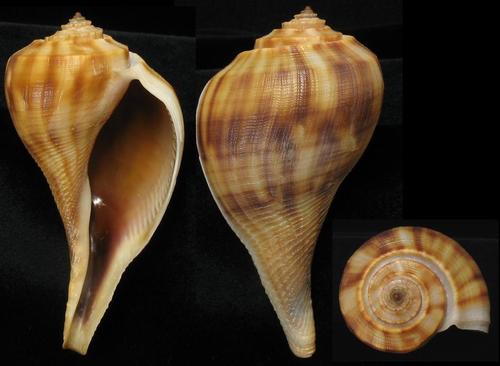
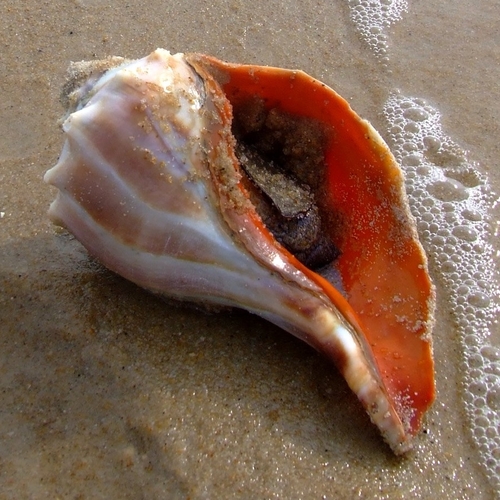
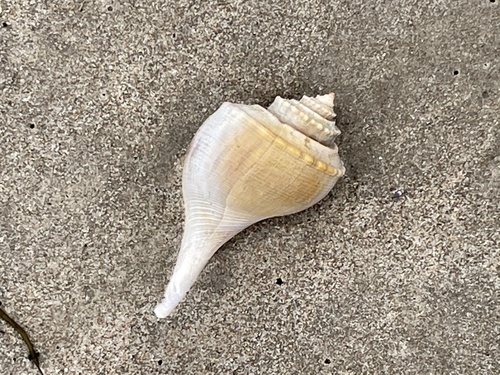
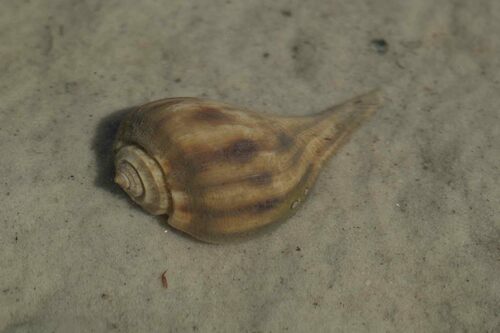
The shell of Sinistrofulgur sinistrum ranges in size between 20 and 45 cm (7.9 and 17.7 in). This species normally has a sinistral, or left-handed, shell, which is the origin of its scientific name. When the shell is held with its spiral end pointing upward, the opening sits on the left side. It has a low spire, a long siphonal canal, and a distinct shoulder at the junction of the spire and body whorl, where small to moderate sized knobs are present. The shell's base color is variable but typically pale, and it is marked with dark stripes that run along its long axis. This is a marine species found in the Gulf of Mexico, the Caribbean Sea, and the North Atlantic Ocean. It also occurs in shallow bays along the Texas Gulf Coast, and has been recorded along the Atlantic coastline from Florida to South Carolina, as well as in parts of North Carolina. Lightning whelks are more common on the west coast of Florida than the east coast of Florida; geographic separation prevents the two populations from interacting or reproducing, leading to morphological differences between them. Major mound sites containing lightning whelk shells in the United States are located in Moundsville, Alabama; Etowah, Georgia; Spiro, Oklahoma; and other areas. This species prefers sandy and muddy sea floors in shallow bays, and it seeks out sunlight. Few predators of the lightning whelk have been recorded, but one confirmed predator is the box crab Calappa flammea. The large size and thick shell of this species mean it has few natural enemies overall. The lightning whelk itself is a predatory gastropod that feeds primarily on bivalve mollusks including clams, oysters, and mussels. One of its main prey items is Mercenaria mercenaria, commonly known as the hard clam. Because S. sinistrum is closely related to its hard clam prey, researchers have studied this relationship to see if relatedness contributes to the established predator-prey dynamic. Research is ongoing to confirm whether the evolution of Sinistrofulgur sinistrum has been driven by adaptations to meet the dietary demands of preying on Mercenaria mercenaria. Sinistrofulgur sinistrum reproduces sexually. Males deposit a sperm packet on the bottom of their foot; after fertilization, females lay eggs inside a series of protective capsules linked together by an egg-case string. Each string can hold up to 175 egg capsules, with 20 to 100 eggs contained in every capsule. The mother anchors the entire egg-case string to mud or sand. When juveniles are ready to hatch, they exit the egg capsule through a small capsule port. Since this species is carnivorous for its entire lifespan, juvenile S. sinistrum will feed on unhatched eggs inside the capsule before emerging.