About Simmondsia chinensis (Link) C.K.Schneid.
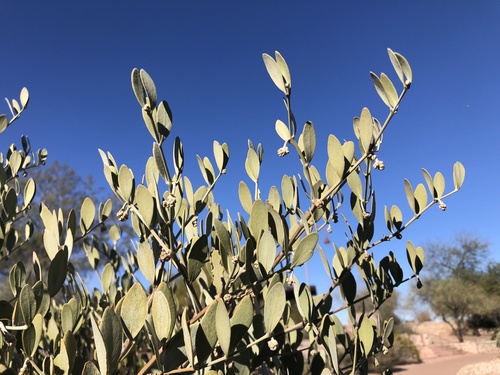
Simmondsia chinensis, commonly known as jojoba, most often grows 1–2 meters (3.3–6.6 ft) tall, with a broad, dense crown, though some plants have been recorded reaching 3 meters (9.8 ft) in height. Its leaves are arranged oppositely, have an oval shape, and measure 2–4 centimeters (0.79–1.57 in) long by 1.5–3 centimeters (0.59–1.18 in) wide. They are thick, waxy, and glaucous gray-green in color. Jojoba is an evergreen plant, but will sometimes drop its leaves in response to severe drought. Its flowers are small, greenish-yellow, with 5–6 sepals and no petals, and the plant typically blooms from March to May. Jojoba is a native shrub that grows in the Sonoran Desert, Colorado Desert, Baja California desert, and California chaparral and woodlands habitats of the Peninsular Ranges and San Jacinto Mountains. It is found in southern California, Arizona, and Utah in the United States, and in Baja California state, Mexico. Endemic to North America, it occupies an area of approximately 260,000 square kilometers (100,000 sq mi) between 25° and 31° North latitude, and 109° and 117° West longitude. Jojoba is almost entirely dioecious, meaning individual plants are either male or female; hermaphrodite plants are extremely rare. In wild populations, the ratio of males to females is 5 to 1. Its fruit is an acorn-shaped ovoid, three-angled capsule 1–2 centimeters (0.39–0.79 in) long, partly enclosed at the base by the sepals. The mature seed is a hard, dark brown oval that contains approximately 54% oil, which is a liquid wax. An average-sized jojoba bush produces 1 kilogram (2.2 lb) of pollen, to which few humans are allergic. Female plants produce seeds from flowers pollinated by male plants. Jojoba leaves have an aerodynamic shape that creates a spiral effect, which carries wind-borne pollen from male flowers to female flowers. While male jojoba flowers are attractive to bees and act as a pollen source, jojoba is primarily anemophilous (wind-pollinated) because its female flowers are not attractive to pollinators. Pollination occurs in February and March in the Northern Hemisphere, and in August and September in the Southern Hemisphere. Jojoba foliage provides year-round food for many animals, including deer, javelina, bighorn sheep, and livestock. Its seeds are eaten by squirrels, rabbits, other rodents, and larger birds. Only Bailey's pocket mouse is known to be able to digest the wax found inside jojoba seeds. In large quantities, jojoba seed meal is toxic to many mammals; this effect is caused by simmondsin, a compound that inhibits hunger. In humans, the indigestible wax acts as a laxative. Consistent use of jojoba oil is thought to help regulate the skin's oil production. It also has a longer shelf life than other natural oils, making it a durable ingredient in skincare products. Medicinally, jojoba oil can relieve headaches and throat inflammation, and treat wounds. It has anti-inflammatory, antimicrobial, antifungal, and insecticidal properties. After oil is extracted from the seeds, the leftover jojoba meal can be used as a low-cost livestock feed. Jojoba leaves contain antioxidant flavonoids, which have been studied for their potential use in treating asthma, inflammation, and cancer. Native Americans were the first to use jojoba. In the early 18th century, Jesuit missionaries on the Baja California Peninsula observed indigenous peoples heating jojoba seeds to soften them, then grinding them with a mortar and pestle to create a salve or buttery substance. This preparation was applied to the skin and hair to heal and condition it. The O'odham people of the Sonoran Desert treated burns with an antioxidant salve made from jojoba seed paste. Native Americans also used the salve to soften and preserve animal hides. Pregnant women ate jojoba seeds, believing they assisted during childbirth. Hunters and raiders ate jojoba while traveling to keep hunger at bay. The Seri people, who use nearly every edible plant in their territory, do not consider jojoba seeds a proper food, and historically only ate them in emergencies. Today, jojoba is grown commercially for the liquid wax, commonly called jojoba oil, contained in its seeds. This oil is unusual because it is an extremely long (C36–C46) straight-chain wax ester, not a triglyceride. This makes jojoba and its derivative jojoba esters more similar to whale oil than to traditional vegetable oils. Jojoba oil has been proposed as a possible biodiesel fuel, but it cannot be cultivated on a large enough scale to compete with traditional fossil fuels, so its use is currently restricted to personal care products. Jojoba plantations have been established in a number of desert and semi-desert areas, predominantly in Argentina, Australia, Israel, Mexico, Peru and the United States. It is currently the second most economically valuable native plant in the Sonoran Desert, outranked only by Washingtonia filifera (California fan palm), which is used as an ornamental tree. Jojoba prefers light, coarsely textured soils with good drainage and water penetration. It tolerates salinity and nutrient-poor soils, and grows best in soils with a pH between 5 and 8. It thrives in young, coarse soils with minimal profile development, which are primarily derived from acid igneous materials and typically found on slopes ranging from over 3 to more than 30 percent grade. North-facing slopes often have better moisture retention, so they can support jojoba (especially young plants) better. Jojoba tolerates high temperatures, but frost can damage or kill it. It can endure summer temperatures up to 46 °C (115 °F), but suffers leaf damage in cold conditions. Seedlings are more vulnerable, experiencing damage or death at temperatures between 3 and 9 degrees below freezing. Drought, freezing conditions, and biotic pressures can all significantly reduce seedling survival. Jojoba grows well at a wide range of elevations, from sea level to lower mountain slopes. In Arizona's Sonoran Desert, it is most commonly found between 600 and 1,300 m (2,000 and 4,300 ft), an elevation range that provides an ideal environment with well-drained, dry slopes or wadi beds, where water runoff can support growth. Jojoba has minimal growing requirements and does not need intensive cultivation. Weed issues only occur during the first two years after planting, and there is little insect damage. It is well-suited for areas with low annual precipitation, typically flourishing where annual precipitation exceeds 355 mm (14 in), but can grow and survive with less than 100 mm of precipitation annually. The optimal precipitation range for growth is between 450 and 500 mm (18 and 20 in), which provides sufficient moisture. Sufficient water availability is necessary during seed development, however. Supplemental irrigation can maximize production in areas where annual rainfall is less than 400 mm (16 in). High levels of fertilization are not needed, but nitrogen improves growth, especially during the first year after planting. Jojoba is normally harvested by hand, because seeds do not all mature at the same time. Yield is around 3.5 tonnes per hectare (3,100 lb/acre), depending on the age of the plantation. Selective breeding programs are developing new jojoba varieties that produce more seeds with higher wax content, as well as other traits that make harvesting easier. By selecting appropriate elevations and ensuring proper water management, farmers can establish successful jojoba plantations that yield high-quality oil. As interest in sustainable agriculture grows, jojoba is seen as a promising crop for arid regions, providing economic benefits while thriving in challenging growing conditions. Its ability to withstand high salinity up to 12 ds ⋅ m−1 at pH 9, combined with the high value of jojoba products, makes it a promising candidate for combating desertification. It has already been used to combat and prevent desertification in the Thar Desert in India. Research continues into ways to further increase jojoba yields, with findings on effective pruning techniques already expected to improve production.

