About Silybum marianum (L.) Gaertn.
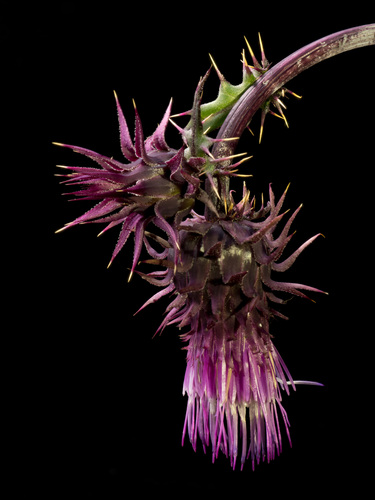
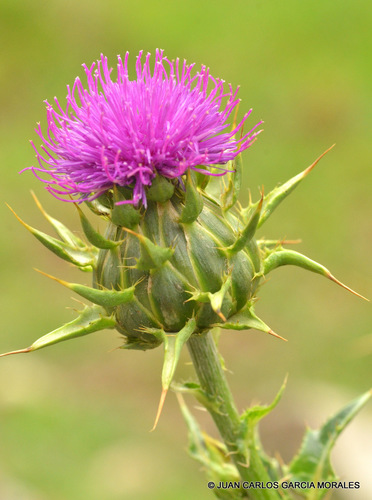
Silybum marianum, commonly called milk thistle, is an upright, overall conical herb that grows 30 to 200 cm tall, with an approximate maximum base diameter of 160 cm. Its stems are grooved, may be covered in light cottony fuzz, and are hollow in the largest specimens. Leaves are oblong to lanceolate, 15–60 cm long, typically pinnately lobed, with spiny edges like most thistles. They are hairless, shiny green, and marked with milk-white veins. Flower heads measure 4 to 12 cm in both length and width, and are red-purple in colour. Flowering occurs from June to August in the Northern Hemisphere, or December to February in the Southern Hemisphere. Each flower head is surrounded by bracts that are hairless, with triangular spine-edged appendages tipped by a stout yellow spine. Fruits are black achenes with a simple long white pappus, surrounded by a yellow basal ring. The long pappus acts as a parachute to support wind dispersal of seeds. Silybum marianum is native to a range extending from around the Mediterranean and most of Europe through Central Asia to India, and reaches as far south as Ethiopia in Africa; it may also be native near the coast of southeast England. It has been widely introduced outside its natural range, including into North America, Hawaii, Australia, New Zealand, and Colombia, where it is considered an invasive weed. It also spreads invasively across almost all of Europe as a result of field cultivation. This species establishes itself in sunny, warm ruderal meadows in regularly disturbed places such as rubble deposits, at the foot of south-facing walls, near villages, on urban fallow land, or on cattle pastures. It does not prefer dry, stony soils. Milk thistle has been observed to potentially modify fire regimes in its invasive range, and fire may also encourage its invasion into new habitats. Compared to other plant-based dietary supplements, milk thistle-based supplements have been measured to have the highest mycotoxin concentrations, reaching up to 37 mg/kg. Use of milk thistle may cause stomach upset and trigger allergic reactions in some people. Eyelid edema, ocular pruritus, dry eye, diplopia, and blurred vision are among the reported complications, based on registered side effects in the WHO global database of adverse drug reactions. Due to its nitrate content, the plant is toxic to cattle and sheep. When ruminants consume potassium nitrate, stomach bacteria break the chemical down to produce nitrite ions. Nitrite ions then combine with hemoglobin to form methemoglobin, which blocks oxygen transport, resulting in a form of oxygen deprivation. Milk thistle is an adaptive crop with low growing requirements. It is mainly cultivated as a medicinal plant, but is also sometimes used as a food source. Cultivation occurs mainly in Europe, and also takes place in Asia and North America. Milk thistle is a biennial plant, but is normally grown as an annual to simplify cultivation; when the plant's core requirements are met, it will bloom in the first year. It has low soil nutrient requirements and is drought resistant. The optimal soil pH for growth ranges from 5.5 to 7.6, but a wide pH range is acceptable. Seeds are sown directly into soil at a depth of 1 to 1.5 cm. A minimum temperature of 2 °C is required for germination. Sowing can be done in autumn or spring, depending on climate conditions. Row spacing ranges from 40 to 75 cm, with plants spaced about 25 cm apart within rows. Fertilization is not required due to the plant's low nutrient needs, but a standard fertilization rate of 50 kg nitrogen, 30 kg phosphorus, and 60 kg potassium per hectare is applied before sowing to improve yields. Harvest normally takes place in July or August. Since flower heads do not ripen evenly, the optimal harvest time is about two weeks after 50% of the flower heads are dry. A standard cereal combine harvester can be used for harvesting. In Poland, average yields are 1230 kg per hectare, with an average silymarin content of 26.5 kg per hectare. Although it can be allergenic, milk thistle leaves and stems can be collected before bloom, have their spines removed, and then boiled with salt for consumption. The roots are edible raw or roasted, and the flower head can be cooked like a globe artichoke. While milk thistle has been used in traditional medicine for centuries, there is no clinical evidence supporting any medicinal effect as of 2020. Silymarin is extracted from milk thistle seeds and sold as a standardized extract. In 2019, Cancer Research UK stated: "We need a lot more research with reliable clinical trials before we can be sure that milk thistle will play any part in treating or preventing cancers."