About Silurus glanis Linnaeus, 1758
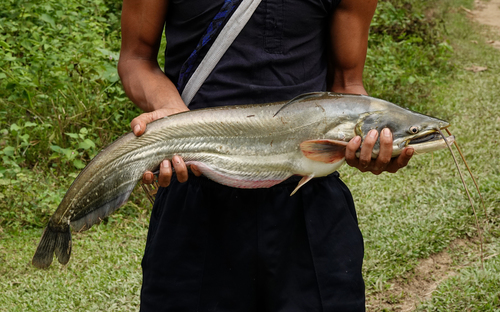
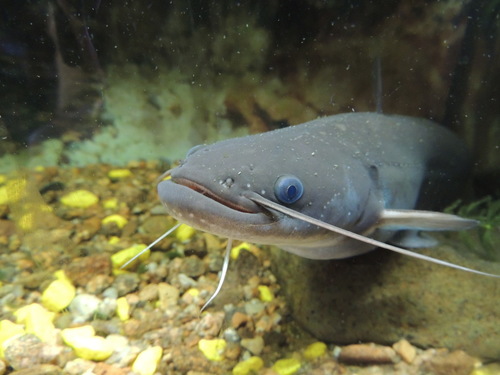
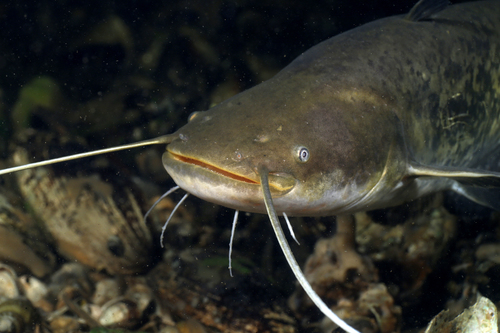
The wels catfish (Silurus glanis Linnaeus, 1758) has lines of numerous small teeth in its mouth, two long barbels on the upper jaw, and four shorter barbels on the lower jaw. It has a long anal fin that extends to the caudal fin, and a small sharp dorsal fin located relatively far forward. This species relies largely on hearing and smell to hunt prey, thanks to its sensitive Weberian apparatus and chemoreceptors. Like many other catfish, wels catfish have a tapetum lucidum, which gives their eyes increased sensitivity at night, the time when the species is most active. Using its sharp pectoral fins, the wels catfish creates an eddy to disorient its victim, then sucks the prey into its mouth and swallows it whole. The wels catfish has very slimy skin. Its skin colour changes based on its environment: fish in clear water are black, while those in muddy water are typically green-brown. Its underside is always pale yellow to white. Albinistic wels catfish have been recorded, and are caught occasionally. This species has an elongated body shape, which allows it to swim backwards like eels. Female wels catfish can produce up to 30,000 eggs per kilogram of their own body weight. Males guard the nest until the brood hatches; hatching takes between three and ten days depending on water temperature. If the water level drops too much or too quickly, male wels catfish have been observed splashing water onto the eggs with their tails to keep them wet. The wels catfish is a long-lived species; a 70-year-old specimen was captured in a recent study in Sweden.
Wels catfish live in large, warm lakes and deep, slow-flowing rivers. They prefer to stay in sheltered locations such as riverbed holes and sunken trees. They feed in open water or deep areas. They are kept in fish ponds as food fish. One unusual habitat for this species is within the Chernobyl exclusion zone, where a small population lives in abandoned cooling ponds and channels close to the decommissioned power plant. These catfish are healthy and act as top predators in the local aquatic ecosystem.
Wels catfish are generally valued as food only when they are young. Their flesh is more palatable when the fish weighs less than 15 kg (33 lb). Larger individuals have very fatty flesh, and may accumulate high levels of toxic contaminants through bioaccumulation because they sit at the top of the food chain. Large specimens are not recommended for consumption, but are popular targets for recreational fishing due to their combative behavior when caught. A clonk, a device that produces a distinct sound when lowered into the water, is a common lure used to entice wels catfish to bite.