About Silurus asotus Linnaeus, 1758
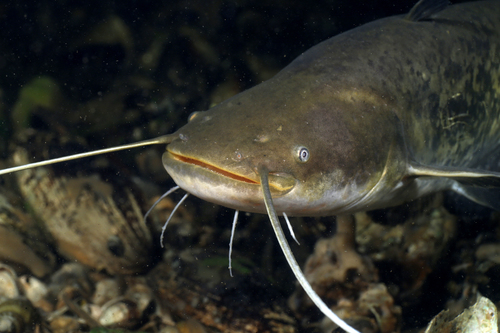
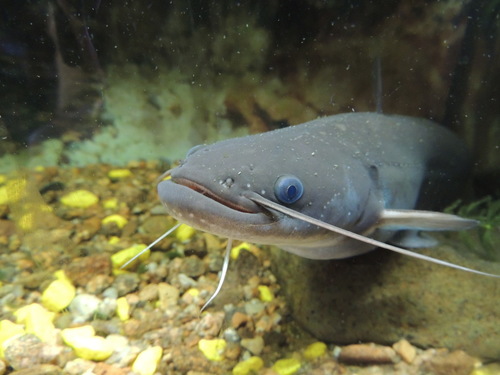
Silurus asotus Linnaeus, 1758 is a member of the family Siluridae. This species has a robust, elongated body. It grows roughly 20–50 cm per year, and can reach a maximum total length of 1.5 meters. S. asotus has a distinct appearance, with a flattened, broad head and a terminal mouth that holds many small, sharp teeth. Its body is covered in smooth, scaleless skin. Its body color is variable, ranging from olive-green to yellowish-brown, with irregular white spots along its sides. One of the species' most notable features is the long, filamentous barbels that grow from the corners of its mouth. These sensitive structures help the fish find food, since S. asotus is primarily a nocturnal predator. Both juvenile and adult individuals have one pair of maxillary barbels that are longer than the head, plus one pair of mandibular barbels that measure around 20 to 30% of the length of the maxillary barbels. Juvenile fish with a standard length of 6 to 7 cm (2.4 to 2.8 in) have an extra pair of mandibular barbels. S. asotus is adapted to a wide range of freshwater habitats with temperatures between 20 and 27 °C (68 to 81 °F), and is found in Taiwan, China, Japan, and all rivers of Korea. S. asotus is a common freshwater fish in Eastern Asia, and prefers large freshwater bodies such as slow-moving rivers, irrigation canals, and lakes. It favors environments with dense aquatic vegetation, flowing water, and low light, which aligns with its daytime sleeping habits. S. asotus usually reproduces during warmer months, most often in spring or early summer, when water temperatures are suitable. This typically occurs after a rainy season. Fertilized eggs of S. asotus can be identified by their distinct green color, and larger eggs have a higher survival rate than smaller eggs. Hatching takes place around 27 hours after eggs are laid, and this duration is affected by water temperature. In colder water, hatching takes up to around 48 hours. During spawning, S. asotus scatters its eggs, a reproductive strategy thought to reduce mortality among juvenile fish. The species has a noticeably skewed sex ratio that heavily favors females. There is documented intraspecific variation in reproductive ecology, particularly in mating behavior, across local populations. For example, the population found in Lake Biwa follows a consistent sequence of mating actions: chasing, clinging, the male enfolding and squeezing the female, then paired circling. In this population, each female is always enfolded by only a single male.