About Sillago schomburgkii Peters, 1864
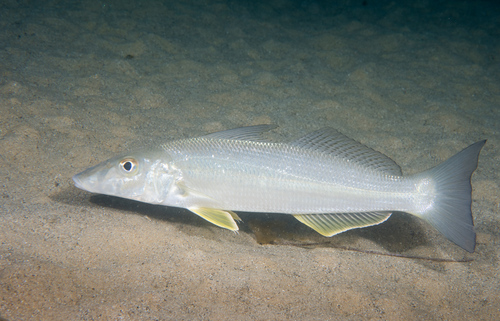
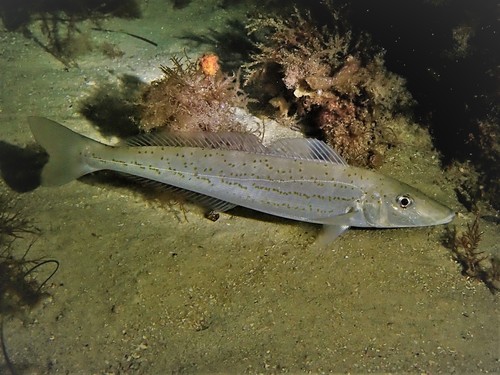
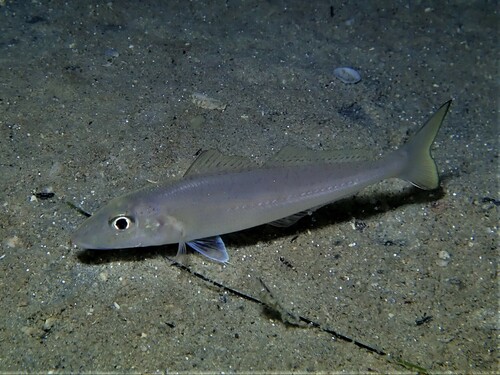
Description: The yellowfin whiting (Sillago schomburgkii) shares a similar body profile with most other Australian sillaginids. Its key identifying features are its coloration and swimbladder morphology. It is one of the largest members of the Sillaginidae family, with a confirmed maximum length of 42 cm and maximum weight of 860 g. Its body is elongate and compressed, with a more arched dorsal profile than ventral profile. It has a small, oblique mouth, with a broad band of villiform teeth in each jaw. It has two slightly separated dorsal fins: the first has 10 to 12 spines, and the second has 1 spine followed by 19 to 22 soft rays. The anal fin has 2 spines followed by 17 to 20 soft rays, the ventral fin has 1 spine and 5 soft rays, and the pectoral fin has 15 to 16 rays. The emarginate caudal fin is made up of 17 rays. The body is covered in small ctenoid scales that extend to the upper head and nostrils, and scales are also present behind each ray of the dorsal and anal fins. The lateral line contains 66 to 76 scales, and the cheek has 4 or 5 rows of ctenoid scales. This species has a total of 37 vertebrae. Its swimbladder has an incised anterior margin with no median or anterolateral projections, a single tapering posterior extension that rapidly narrows into a slender tube, and a duct-like process on its ventral surface. Yellowfin whiting are sandy brown to pale silvery grey, with a darker dorsal surface and paler underside. A narrow silver mid-lateral band sits below a brownish band, though these bands may be pale or indistinct. Both dorsal fins are hyaline with rows of small brown spots; the anal fins are pale yellow with a cream margin. The ventral fins are also yellowish, and the pectoral fin is pale yellow to hyaline with fine dusting and no dark spot at its base. As yellowfin whiting grow, the yellow color of their fins often fades, and may be completely absent in large specimens. The caudal fin is greyish. Distribution and habitat: Yellowfin whiting is endemic to eastern Indian Ocean waters off southwestern Australia, and is thought to form two separate populations: one in Western Australia and one in South Australia. The western population ranges from Dampier south to Albany, with no records of the species between Albany and Spencer Gulf further east. The southern population occurs in Spencer Gulf and Gulf St Vincent, extending eastward to the Fleurieu Peninsula. Yellowfin whiting primarily inhabit shallow protected inshore waters less than 10 m deep, and often move across tidal flats less than one meter deep. They are commonly found on sand flats, bars, and spits, as well as mangrove-lined tidal creeks, mud flats, seagrass beds, and estuaries. They move with the tide: they push into the shallows of creeks and flats to forage at high tide, and retreat to the sandy hollows of deeper slopes of channels and banks as the tide falls. In Western Australia, they often enter large, sandy estuaries such as the Swan and Leschenault Estuary, where they can reach the limits of brackish water, showing they can survive in low salinity environments. They have also been recorded in the extremely saline waters of upper Spencer Gulf and Shark Bay, indicating a wide tolerance to salinity. In South Australia, juveniles occupy the same environments as adults, but in Western Australia adults move from tidal creeks and seagrass beds to more sand-dominated environments including high-energy beaches. Reproduction and growth: Male yellowfin whiting reach sexual maturity at 200 mm in length, and females at 230 mm. Most individuals of both sexes reach maturity by the end of their second year of life. Spawning timing varies across the species’ range, a trait seen in many other sillaginids. In the northernmost part of its range (Shark Bay), spawning occurs between August and December. Further south in southern Western Australia, spawning occurs between December and February. The South Australian population also spawns between December and February. Before spawning, fish move into shallow tidal and estuarine regions where spawning takes place. Ripe individuals leave the main schooling group to form smaller spawning schools, where eggs are released. There is conflicting data on the spawning pattern of yellowfin whiting: an earlier Shark Bay study found the species to be a single spawner, while recent southern studies indicate they are multiple spawners. After spawning in South Australia, fish disperse and move further offshore again. Females release between 170,000 and 217,000 eggs per season. The eggs are pelagic and spherical, with a diameter of 0.6 mm. The development and morphology of newly hatched yellowfin whiting larvae has been extensively described in ichthyological literature. By the time larvae reach 2.7 mm in length, their mouth and gut are functional, their eyes are pigmented, a gas bladder is present, and yolk absorption is complete. Larvae are elongate, with 36 to 38 myomeres, and flexion occurs by 4.8 mm. Juveniles appear in Western Australian estuaries during March, and their subsequent growth is fairly rapid. Even so, yellowfin whiting is one of the slower growing sillaginid species, though it reaches a much larger maximum size than most of its relatives, with a confirmed maximum length of 42 cm. On average, individuals measure 8 cm after their first year and weigh between 60 and 190 g. By the end of their second year, they reach 24 cm, and females are thought to grow slightly faster than males. The oldest known recorded individual was a 12-year-old female measuring 35 cm, while the oldest known male was at least 7 years old and measured 34.8 cm.