About Sillago ciliata Cuvier, 1829
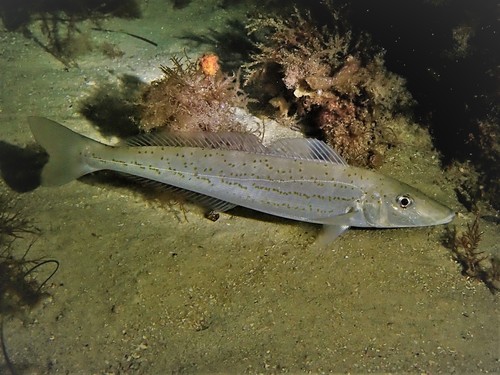
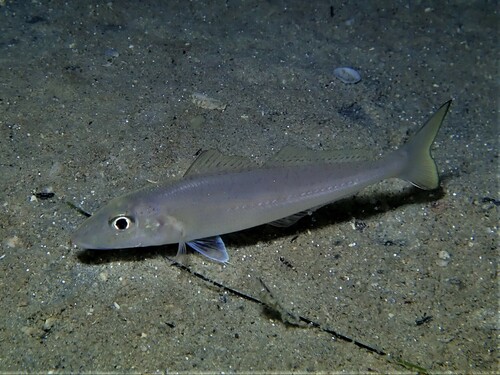
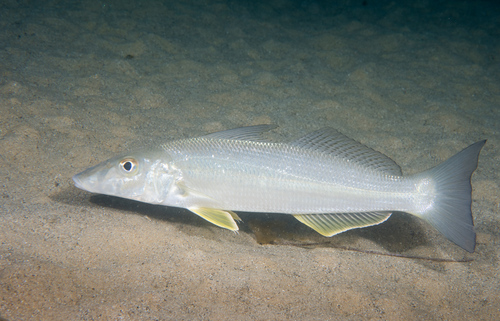
Sillago ciliata, commonly known as the sand whiting, has a body profile very similar to other members of the genus Sillago: it is slightly compressed, elongate, and tapers toward a terminal mouth, with a straight ventral profile. Its dorsal fin is split into two sections: the first section is made of weak spines, and the second is made of soft rays, led by a single weak spine. This species reaches a maximum recorded size of 51 cm in length and approximately 1.25 kg in weight. Fin anatomy is highly helpful for identifying the species: the first dorsal fin has 11 spines, while the second dorsal fin has one spine and 16 or 18 soft rays. The anal fin has two spines, followed by 15 to 17 soft rays. Lateral line and cheek scales are also distinct: sand whiting have 60 to 69 lateral line scales, and cheek scales arranged in 3 to 4 rows, all of which are ctenoid. Total vertebrae count is also a diagnostic feature, ranging from 32 to 34. The swim bladder has rudimentary tubules that project anteriorly, and a series of lateral tubules that decrease in size and become sawtooth-shaped toward the posterior. A single tapering posterior extension reaches well into the caudal region, and a duct-like process extends from the ventral surface to the urogenital opening. Swim bladder morphology cannot be used to distinguish S. ciliata from S. analis, as the two species have nearly identical swim bladders. The body is pale brown to silvery brown, fading to white on the underside, and develops green, mauve, and rosy reflections when the fish is first taken out of water. Some specimens have an indistinct silver-yellow mid-lateral band across their body. The spinous dorsal fin is olive green with faint darker blotches, and the second dorsal fin is pale olive with rows of dark brown to blackish spots. The anal and ventral fins are pale yellow, and the pectoral fins are pale yellow to pale brown with a clearly defined dark blue-black blotch at the base. The caudal fin is yellow to olive with darker margins. Juveniles under 90 mm in length may have darker blotches along their sides and backs. The sand whiting is distributed along the east coast of Australia, ranging from Cape York, Queensland, south along the coast and Great Barrier Reef to eastern Victoria and the east coast of Tasmania as far south as Southport. It also occurs on several islands: Lord Howe Island, New Caledonia, and Woodlark Island in Papua New Guinea. The species is most abundant in southern Queensland and New South Wales, where sampling has found it present in every estuary surveyed; in contrast, it has a very patchy distribution along the coast of northern Queensland. The sand whiting is an inshore species that lives in exposed coastal habitats including beaches, sandbars, and surf zones, as well as more sheltered bays, estuaries, and coastal lakes. Sand whiting enter estuaries—including intermittently open ones—and travel far upstream to the tidal limits of rivers and creeks, where juvenile and adolescent fish are often abundant. Adults gather around estuary mouths, bars, and spits at depths of up to 5 m, and can make up a large proportion of the ichthyofauna in these areas. As their common name suggests, they are most often found exclusively on sandy substrates, though they occasionally occur in Zostera seagrass beds. Individual sand whiting are sometimes caught in offshore waters down to 40 m depth during winter. Like many fish species, spawning timing varies across the sand whiting's range: gonad development shows spawning occurs from December to April in the southern New South Wales region, and from September to February in southern Queensland. Two spawning events occur each year, which is confirmed by two distinct egg size classes found in ovaries and two annual recruitment pulses when young fish move into juvenile habitats. Spawning takes place at estuary mouths or in surf zones, and larvae develop in fully marine waters. Juveniles grow to 16.5 cm in length after their first year, 26.7 cm after their second year, and 30.5 cm after their third year. After the start of the spawning season, young whiting 10 mm and longer can be seen swimming actively in small groups of 10 to 20 on the sand flats and beaches where they are recruited. They move up and down with the tide, swimming in very shallow water up to 1 m deep. Unlike closely related sillaginid species, whose juveniles typically use seagrass and mangroves for protection, juvenile sand whiting usually prefer unprotected sandy substrates. As they mature, they move further from the shore.