About Sillaginodes punctatus (Cuvier, 1829)
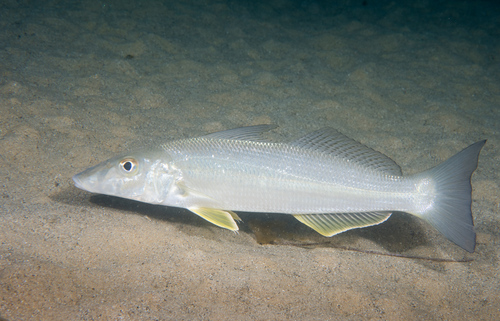
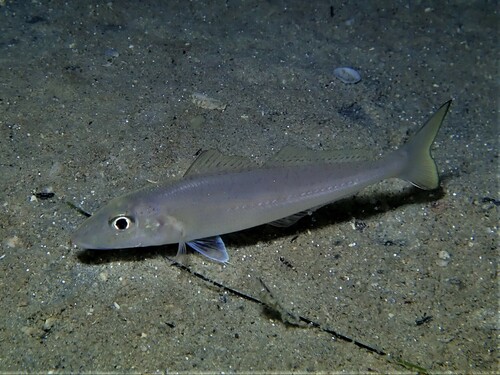
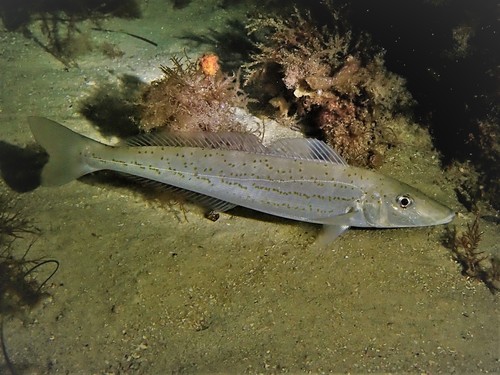
King George whiting (Sillaginodes punctatus) shares the general body shape common to all sillaginid fishes: it has an elongated, slightly compressed body, a tapering head, and a terminal mouth. The monotypic genus Sillaginodes (the only species of this genus is King George whiting) is defined by having 12 to 13 spines in the first dorsal fin, plus a single spine and 25 to 27 soft rays in the second dorsal fin. Members of this genus have between 42 and 44 vertebrae. King George whiting is further distinguished from any other potential taxa in the genus by several unique anatomical features. It is the largest fish in the Sillaginidae family, with 129 to 147 lateral line scales. Like all sillaginids, it is most reliably identified by the shape of its swim bladder. Viewed from above, the swim bladder resembles a land slug, with a posteriorly tapering extension and two anterolateral extensions called 'horns'. Unlike species in the genus Sillago, it has no duct-like processes on the swim bladder's ventral surface. For quick identification, King George whiting has very distinctive coloration: its dorsal surface ranges from pale golden brown to olive brown, and its underside is white to silver. The species also has distinct, obliquely arranged rows of brown spots running the full length of its body, which remain clearly visible even after the fish is removed from water and after death. The caudal, anal, and pectoral fins are usually light brown, and some individuals have olive green caudal fins. The species grows to a maximum length of 72 cm and a maximum weight of 4.8 kg. King George whiting is endemic to southern Australia, ranging from lower Western Australia through South Australia and Victoria, and is occasionally found as far east as lower New South Wales. The westernmost confirmed capture was in Jurien Bay, and the easternmost record is from Botany Bay in New South Wales, though this is a very rare occurrence. The species is most commonly found in tidal bays, estuaries, and creeks along the mainland coast and on the many islands scattered across its range. There is a clear difference in habitat use between adult and juvenile King George whiting. Juveniles mostly live in shallower waters of protected bays, creeks, and estuaries. Young fish favour Zostera and Posidonia seagrass beds in protected bays, using the seagrass for protection and foraging. Juveniles form schools of varying sizes, and sometimes school with other species including other members of the Sillaginidae family. Adults are typically solitary and inhabit deeper water across a range of habitats including bays, offshore surf gutters, broken bottom, and deep reef; they also occasionally move into shallower water. King George whiting reach sexual maturity at three to four years of age, when males grow to 30 cm in length and females grow to 34 cm. These length thresholds are used as guides when setting minimum legal capture sizes, to give individuals enough time to reproduce before being caught. Spawning occurs in different areas depending on the geographic location of the population: some groups spawn in deeper water up to 9 m deep, while others spawn in estuaries. Spawning most commonly takes place in May and June, though spawning events have been recorded as early as February and as late as July. Ocean currents carry juvenile fish to their recruitment habitats, as studies show the species is too weak a swimmer to complete long-distance movements on its own. The location of spawning also influences where juveniles settle, which applies particularly to estuary-spawning individuals.