About Siliqua patula (Dixon, 1789)
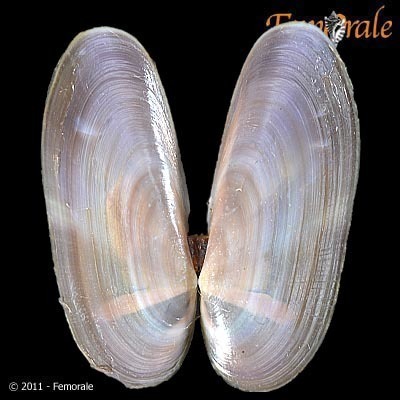
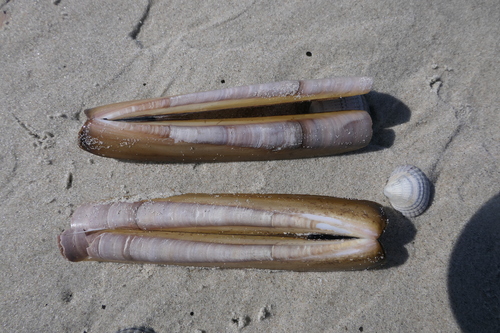
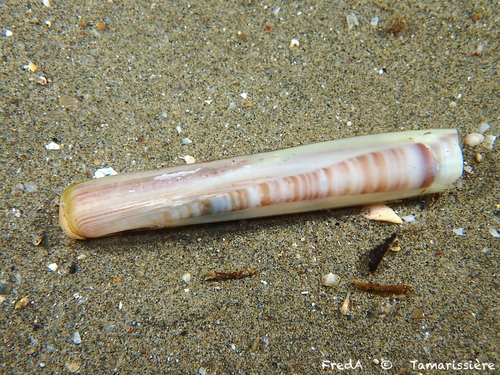
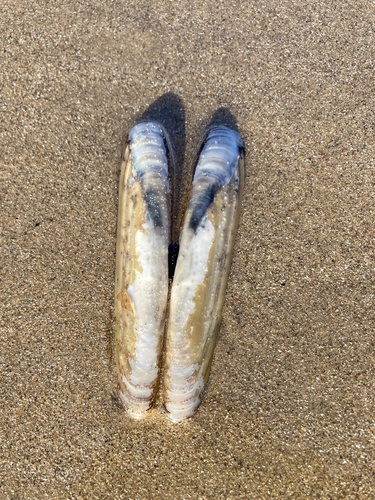
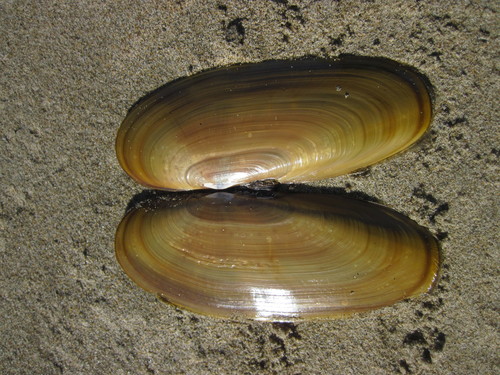
This species, Siliqua patula, commonly known as the Pacific razor clam, has an elongated, narrow oval shell. In the southern part of its range, adult shells reach 8 to 15 cm (3 to 6 in) in length, while individuals found in Alaska can grow up to 28 cm (11 in). Shell color changes with the clam’s age and size: young clams are light brown, medium-sized individuals become yellower, and fully grown large clams return to a brown shade. The clam has two main structural components: its shell, which has a zipper-like growth structure called a manifold, and its combined foot and siphon, which it uses to move through sand and acquire food.
It resembles the smaller Atlantic razor clam, Siliqua costata, which occurs on the East Coast of the United States and Europe. Unlike Siliqua costata, the Pacific razor clam is only found in the United States and has an overall lighter shell color. The common name "razor clam" is also used for the Atlantic jackknife clam, Ensis directus. While Ensis directus belongs to a different genus (Ensis) than the Pacific razor clam's genus Siliqua, both species are classified in the same family, Pharidae.
Pacific razor clams are distributed along the West Coast of North America from Alaska to California, found in both the United States and Canada. They inhabit sandy beaches at depths of less than 30 feet (9.1 m) below the water surface, which distinguishes them from another razor clam species, Siliqua sloati. These clams burrow into sandy beaches using their strong muscular foot. To burrow, they orient toward the sand, push downward with their foot, close an internal valve within their shell to push out water from the opposite end, and move downward. This process repeats until the entire clam is fully submerged in sand.
The Pacific razor clam is sexually dimorphic, meaning males and females differ biologically. Fertilization is external, with no mating rituals or internal copulation. Fertilization occurs when surrounding water temperatures rise. Males release sperm into the seawater and sand, and females release eggs into the same environment. Larger females produce and release more eggs, and it has been speculated that a single female can release up to 118.5 million eggs in one spawning event. Although fertilization happens by chance, the large number of eggs released gives a higher probability of successful fertilization. For the first 5 to 16 weeks of life, Pacific razor clam larvae drift and swim freely while developing their shells. After this period, juveniles settle into the sand to begin their benthic life.