About Silene spaldingii S.Watson
Silene spaldingii S.Watson is a rare flowering plant in the family Caryophyllaceae, commonly known as Spalding's silene, Spalding's catchfly, and Spalding's campion. It is native to eastern Washington, eastern Oregon, northern Idaho, and northern Montana in the northwestern United States, with its distribution extending just into British Columbia, Canada. Much of this species' former habitat has been converted to agriculture, so its current range is restricted to the remaining stretches of undisturbed prairie grassland in this region. It faces threats from the degradation and loss of its remaining habitat. In the United States, it is federally listed as a threatened species, and it is designated endangered by the Committee on the Status of Endangered Wildlife in Canada (COSEWIC).
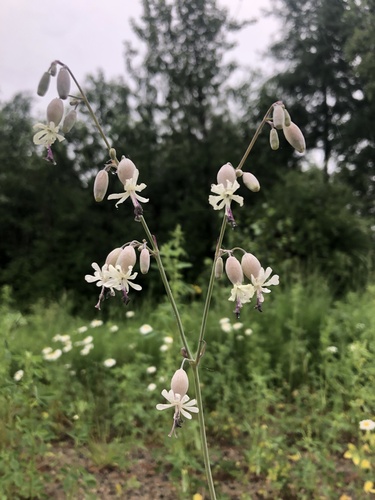
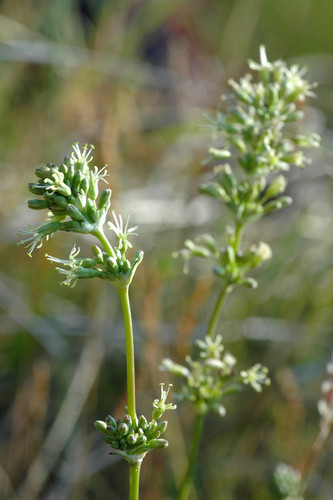
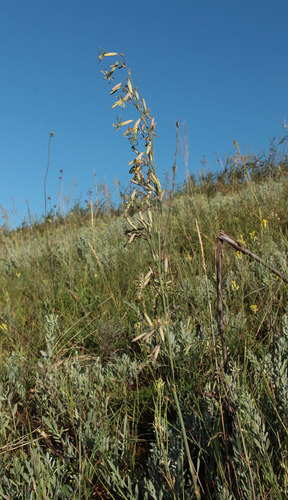
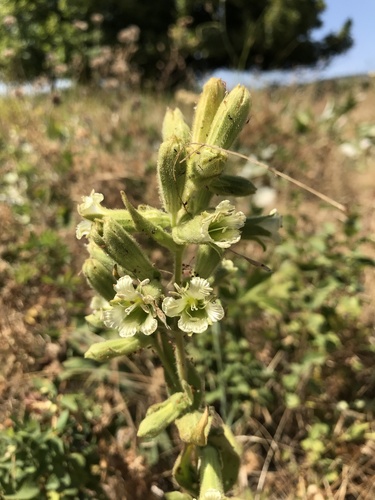
This species is a perennial herb that grows many stems and shoots from a thick taproot and a woody, branching caudex. Stems grow erect, reaching a maximum height of 20 to 60 centimeters (8 to 24 inches), and have a somewhat hairy, sticky texture. Lance-shaped leaves grow in opposite pairs along the stems, with each leaf blade reaching up to 7 centimeters long. The inflorescence is an open cyme bearing flowers with greenish-white petals. The base of each flower is enclosed in a tubular calyx of sepals with 10 veins. This species blooms in June and July, and its flowers are pollinated by the bumblebee Bombus fervidus and the sweat bee Halictus tripartitus.
Silene spaldingii occurs across multiple regions of the northwestern United States and far southern British Columbia, including the Palouse, the Channeled Scablands, the Blue Mountains ecoregion, and the Zumwalt Prairie. The Zumwalt Prairie holds the species' largest population, which numbers over 10,000 individuals. A large percentage of all known populations are located in Montana. Recent surveys have discovered new subpopulations and populations of this species.
The species' distribution has been reduced to patchy, geographically isolated fragments, primarily due to habitat loss to agriculture, an ongoing threat. Additional threats include livestock and wildlife grazing, and invasion by non-native introduced plants; the species cannot tolerate these two types of disturbance. Further threats include lack of a normal fire regime, insect damage, drought, and climate change. In some local areas, gravel mining, herbicides, and off-road vehicles also act as threats.
Populations are generally small, which makes them inherently vulnerable. One example of this vulnerability is a single-plant population in Idaho that was completely eliminated when the individual was buried during road construction. Silene spaldingii exhibits prolonged dormancy: it can persist underground for one or more years at a time, surviving on carbohydrate stores stored in its long taproot. This trait creates difficulties for researchers monitoring the species.