About Silene parishii S.Watson
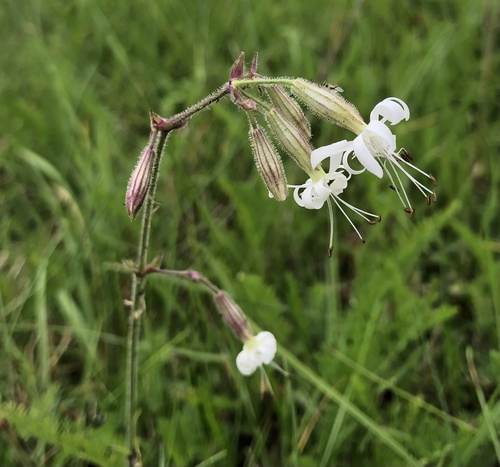
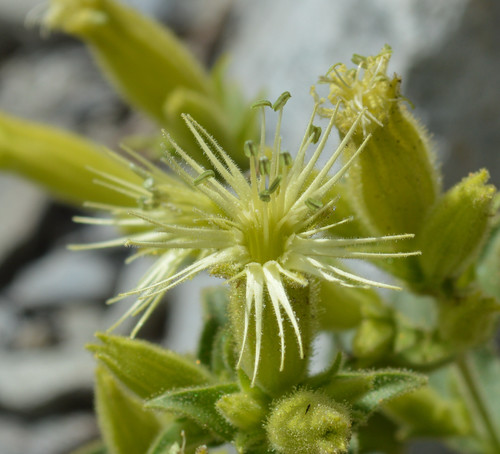
Silene parishii is a species of flowering plant in the Caryophyllaceae family, commonly known as Parish's catchfly. This species is endemic to southern California, where it occurs in several local mountain ranges: the San Bernardino, San Gabriel, and San Jacinto Mountains. It grows in rocky, forested habitat, and can sometimes be found in the alpine climate zone of higher peaks. It is a perennial herb that grows from a woody, branching caudex and taproot, producing several decumbent or erect stems that reach 10 to 40 centimetres in height. Oppositely arranged leaves line the stems, with the largest leaves growing in the middle section of each stem. The leaves are lance-shaped to nearly oval, and can grow up to 6 centimetres long. They have a thick, leathery texture, and are sometimes glandular and sticky. Each flower is enclosed in a tubular calyx made of fused sepals, which can measure nearly 3 centimetres long. This calyx is greenish, marked with ten veins, and covered in a layer of glandular hairs. The five petals are yellowish, and each has around six long, fringelike lobes at the tip.