About Silene nutans L.
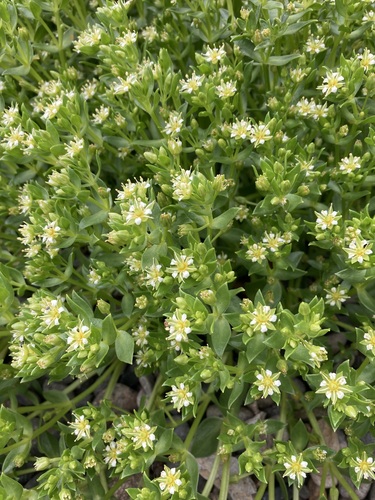
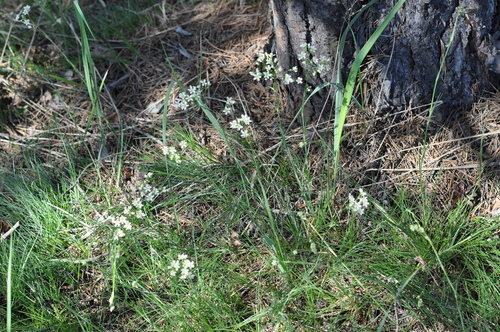
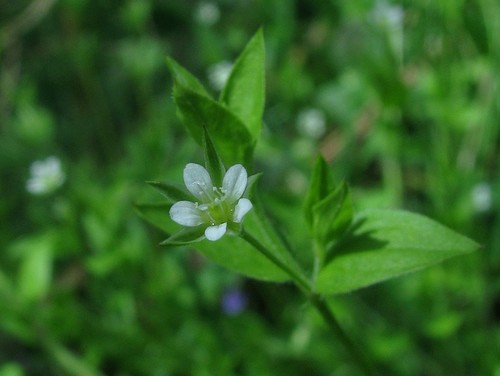
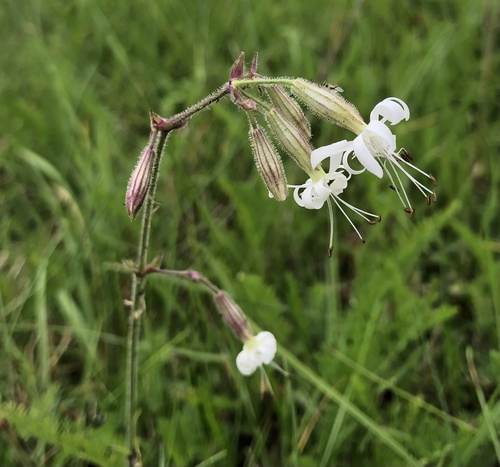
Silene nutans L. is a diploid, mainly outcrossing, herbaceous perennial plant. It grows to a height of 25–80 centimetres (10–31 in) from a branching, woody base with a thick taproot. The plant’s lower leaves grow up to 75 millimetres (3 in) long, are spathulate in shape and have a long stalk, while leaves positioned higher on the stem are lanceolate, nearly stalkless (subsessile) and pointed at the tip. All of the plant’s leaves are covered in soft hairs. The flowers are 18 millimetres (0.7 in) wide, 12 millimetres (0.5 in) long, drooping, and grow on short, sticky stalks. Its petals are white or pinkish and split into two narrow lobes. To reduce the chance of self-fertilisation, each flower stays open for three nights, revealing one whorl of stamens on the first night, the second whorl of stamens on the second night, and the three styles on the third night. The kidney-shaped seeds are 10–22 millimetres (0.4–0.9 in) wide. Silene nutans is widespread across Europe, ranging from southern Spain and Italy north to the British Isles and Scandinavia, and also occurs across large parts of Asia. It has been introduced to North America, where it is called the Eurasian catchfly, and can be found in the U.S. states of Michigan, Ohio, New York, Vermont and Maine. In the British National Vegetation Classification, Silene nutans can sometimes occur in the very widespread MG1 Arrhenatherum elatius grassland community, so it is found growing alongside Arrhenatherum elatius (false oat grass) or Dactylis glomerata (cocksfoot). Across most of its range, Silene nutans is a steppe species. At the edges of its distribution area, it grows in scattered patches in dry habitats, including open grasslands and rock outcrops at forest margins, and tolerates both acidic and alkaline substrates with pH ranging from 3.8 to 8.0. In the far northern part of its range, Silene nutans is a characteristic species of maritime cliffs. Silene nutans flowers at night, and produces a strong floral scent to attract its pollinators, which are mostly night-flying moths. Chemical compounds found in its floral scent include benzyl acetate and benzaldehyde. It also acts as the host plant for the leaf mining moth Coleophora galbulipennella.