About Silene dioica (L.) Clairv.
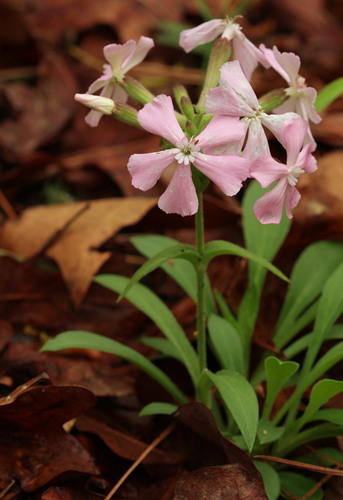
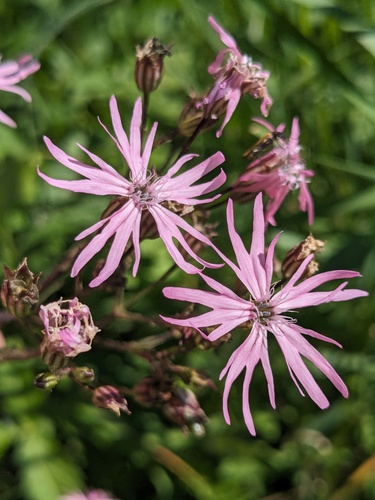
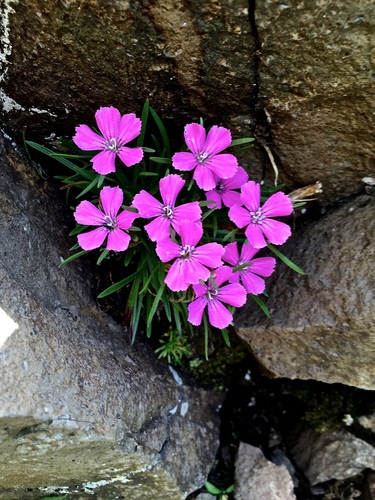
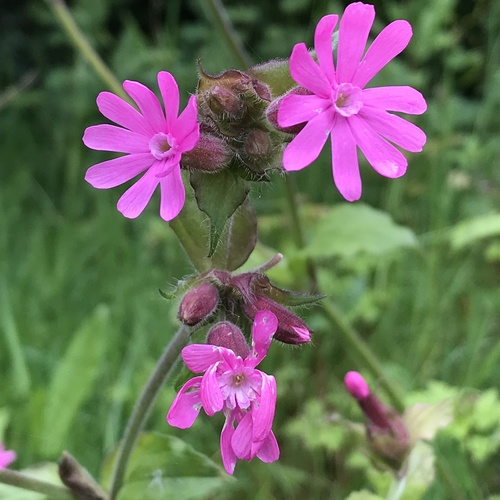
This species, scientifically named Silene dioica (L.) Clairv., is a biennial or perennial plant that grows 30–90 centimetres (12–35 inches) tall, with branching stems. Its deep green leaves grow in opposite, decussate pairs; they are simple, acute, ovate, 3–8 cm (1–3 in) long, with untoothed margins. Both leaves and stems are hairy and slightly sticky, and upper leaves are stalkless. It blooms from May to October, producing unscented flowers that range from dark pink to red. Each flower is 1.8–2.5 cm (3⁄4–1 in) across, with five petals that are deeply notched at the end, narrowed at the base, and fit into an urn-shaped calyx. As its specific epithet "dioica" suggests, male and female flowers grow on separate plants (the species is dioecious). Male flowers have 10 stamens and a 10-veined calyx, while female flowers have 5 styles and a 20-veined calyx. Fruits start forming from July onwards: they are ovoid capsules containing many seeds, which open at the apex via 10 backward-curving teeth. Silene dioica is native to northern and central Europe, and is locally abundant across the British Isles. It is generally common in Northern Ireland, but rare in other parts of Ireland, and common on the Isle of Man. It has been introduced to Iceland, Canada, the United States, and Argentina. Commonly called red campion, it grows in roadsides, woodlands, and rocky slopes, and prefers damp, non-acid soils. In ecology, the flowers are frequently visited by flies including Rhingia campestris. Bumblebees and butterflies use the flower nectar, and several moth species feed on its foliage. Like many other members of the Caryophyllaceae family, red campion is very susceptible to a smut fungus infection. The infecting species here is Microbotryum silenes-dioicae, called anther-smut, which produces a mass of brown spores in the opening of the flower where anthers would normally develop. This plant is grown as an ornamental perennial for perennial borders. A particularly notable cultivated variety is the double-flowered hot pink cultivar with deep green foliage called 'Firefly'. For edible use, the young leaves and flowers of red campion are edible, though cooking or blanching is recommended to remove the bitter aftertaste. Herbalist Nicholas Culpeper recommended red campion to treat warts, corns, kidney disease, internal bleeding, insect stings, and adder bites.