About Siganus vulpinus (Schlegel & Müller, 1845)
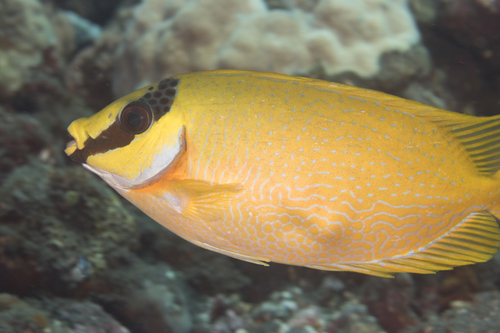
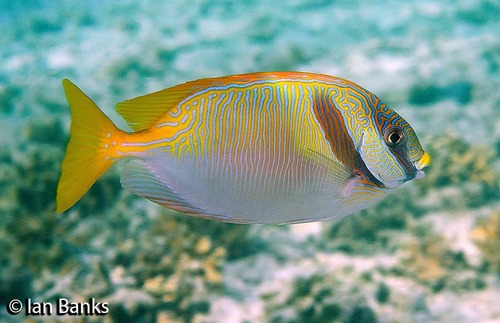
This species, commonly called the foxface rabbitfish, has a compressed body, with body depth measuring 1.9 to 2.4 times its standard length. The dorsal profile of the head is steep behind the eye, with an indentation between the eyes and a tubular snout. Its caudal fin is weakly forked, and a procumbent spine sits on the nape, in front of the dorsal fin. Like all rabbitfishes, its dorsal fin has 13 spines and 10 soft rays, while the anal fin has 7 spines and 9 soft rays. Venom glands are held within the fin spines. This species reaches a maximum total length of 25 cm (9.8 in), though a length of 20 cm (7.9 in) is more typical. The foxface rabbitfish is primarily vivid yellow, with white colouring on the head and the front section of the body. When threatened, this fish can camouflage by quickly changing its colour to dark brown. A black band runs backward from the mouth, through the eye, to the origin of the dorsal fin. There is also a black patch on the breast that extends upward to just above the pectoral fin base, tapering along its upward path. The foxface rabbitfish is found in the far eastern Indian Ocean and the western Pacific Ocean, ranging from Indonesia to the Marshall and Gilbert Islands; it reaches as far north as Taiwan and as far south as New Caledonia and Australia. In Australia, it occurs on northern and offshore reefs of Western Australia, at Ashmore Reef in the Timor Sea, and along the Queensland east coast from the northern Great Barrier Reef to the Capricorn Islands. It has been recorded at depths down to 30 m (98 ft), and inhabits lagoons and seaward reefs that support dense coral growth.