About Siganus virgatus (Valenciennes, 1835)
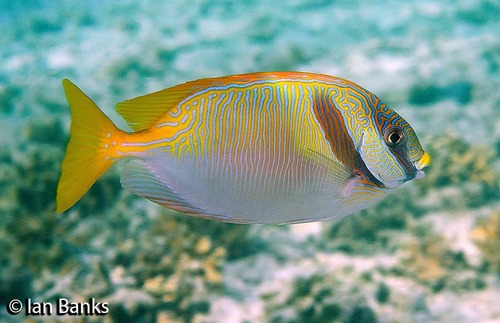
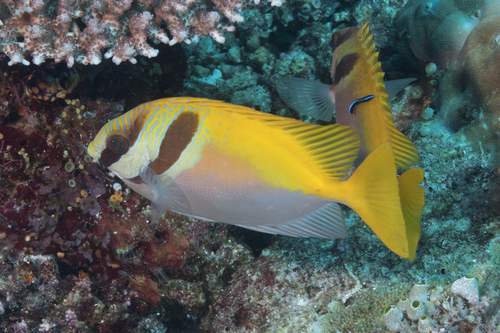
Siganus virgatus has a deep, laterally compressed body, with body depth measuring 1.8 to 2.3 times its standard length. The dorsal profile of the head is bulging, and the front nostril has a high flange that is slightly taller and points toward the rear. A recumbent spine sits in front of the dorsal fin. Like all rabbitfishes, its dorsal fin has 13 spines and 10 soft rays, while its anal fin has 7 spines and 9 soft rays. Venom glands are held within the fin spines. The caudal fin is emarginate in juvenile individuals, and slightly forked in adults. This species reaches a maximum total length of 30 cm (12 in), with 20 cm (7.9 in) being a more typical size. The body is pale, with a silvery white belly. Two wide diagonal dark bands run across the head and anterior portion of the body. The head and front of the body are marked with light bluish spots and lines. The caudal and dorsal fins are yellow, and the species normally has a yellow back and yellow caudal peduncle. Siganus virgatus is native to the Indo-Pacific region, where it occurs from southern India and Sri Lanka eastward to West Papua and Western Australia, and north to the Ryukyu Islands. One individual has been collected off the Adriatic island of Cres, but this occurrence is thought to be the result of either deliberate introduction or transportation via ship ballast. In Australia, the species is found from Western Australia's Ningaloo Reef and Kimberley region along the northern coast to the Wessel Islands in the Northern Territory. It lives in tropical waters, associated with coastal coral reefs, including lagoons and outer reefs. It is most often found in rocky and hard coral areas that have patches of sand, and it can tolerate turbid waters. Large juveniles and adults occur in pairs on reef slopes and in estuaries. Small juveniles live in mangroves, then move to reefs in small groups where they are protected by coral formations. This species is found at depths down to 12 m (39 ft).