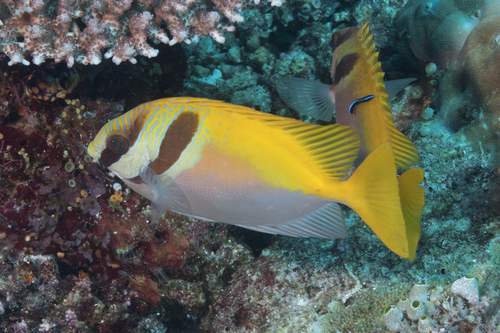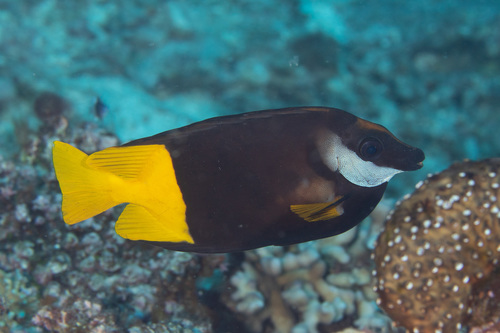
About Siganus uspi Gawel & Woodland, 1974
The bicolored foxface (Siganus uspi) has a deep, laterally compressed body; its body depth is roughly a little over twice the fish's standard length, and it has a weakly forked caudal fin. The opening of its forward nostril is a very short tube that expands slightly to the rear of the nostril, and the species has a procumbent spine in front of the dorsal fin. Like all rabbitfishes, the bicolored foxface has 13 spines and 10 soft rays in its dorsal fin, while its anal fin has 7 spines and 9 soft rays. Its fin spines contain venom glands. This species reaches a maximum total length of 24 centimetres (9.4 inches). Its overall body color is dark purplish brown, except for its yellow pectoral fins, the soft-rayed portion of the dorsal and anal fins, the caudal fin, and the rear part of the body. The boundary between the two colors is sharply defined. The bicolored foxface has only been officially recorded from Fiji; unconfirmed reports exist of vagrant individuals found off New Caledonia. It occurs at depths between 3 and 20 metres (9.8 and 65.6 feet), where it inhabits areas of hard coral on drop-off slopes at reef edges, or in deeper pools within other parts of reefs.