About Siganus stellatus (Forsskål, 1775)
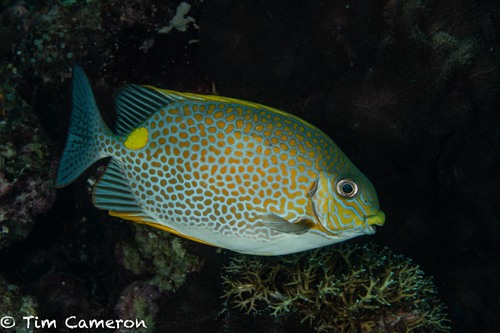
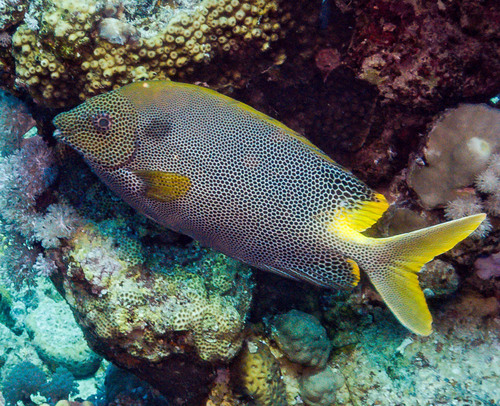
Siganus stellatus has a deep, laterally compressed body, with body depth measuring 2 to 2.3 times its standard length. The dorsal profile of the head is almost straight, with an angle of roughly 45° between the forehead and snout, while the ventral head profile has a slight indentation below the chin. In juvenile individuals, the front nostril has a long triangular flap, which reduces to a low rim in adults. A recumbent spine sits in front of the dorsal fin. Like all rabbitfishes, the dorsal fin has 13 spines and 10 soft rays, while the anal fin has 7 spines and 9 soft rays. The fin spines contain venom glands. The caudal fin is emarginate, and gradually becomes deeply forked as the fish grows. This species reaches a maximum total length of 40 cm (16 in), with 35 cm (14 in) being a more typical size. The body is covered in small, closely spaced dark brown to black spots over a white background, which forms a honeycomb pattern. Fins bear black spots, and the caudal fin, plus the rear edges of the dorsal and anal fins, have a whitish margin. Individuals frequently have a light, whitish to yellowish saddle-shaped mark on the caudal peduncle. In the subspecies S. s. laqueus, the body's background colour is greyish green, and dark brown spots cover the head and entire body. Siganus stellatus occurs from the Red Sea, through the Indian Ocean south as far as South Africa, and east into the Pacific Ocean reaching as far as Singapore. In Australia, this species is only recorded from the Cocos (Keeling) Islands. It inhabits seagrass beds, seaward reefs and lagoons, at depths ranging from 1 to 30 m (3 ft 3 in to 98 ft 5 in). Juveniles are known to enter weedy estuarine habitats.