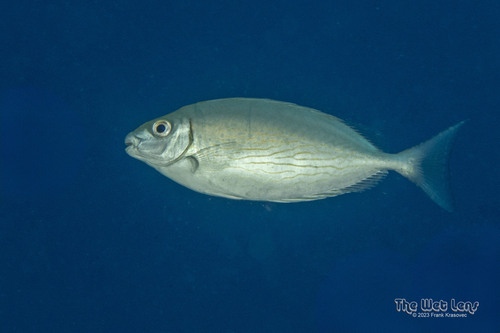
About Siganus rivulatus Forsskål & Niebuhr, 1775
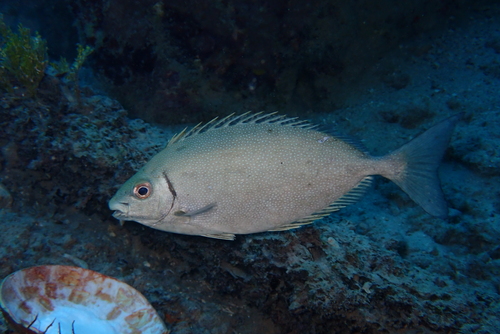
This species is the fish Siganus rivulatus, originally described by Forsskål & Niebuhr in 1775. Siganus rivulatus has a laterally compressed body, where its standard length measures 2.7 to 3.4 times the maximum depth of its body. The dorsal fin of this fish has 14 spines and 10 soft rays, while the anal fin has 7 spines and 9 soft rays; this species has 23 vertebrae, and its caudal fin is slightly forked. The longest spine in the dorsal fin is shorter than the distance between the front of the eye and the posterior edge of the operculum, and the length of the longest soft dorsal fin ray is equal to or shorter than the length of the snout. The slender spines of Siganus rivulatus are barbed and carry venom. Its teeth are shaped like incisors, with lateral cusps, and arranged in a single row in each jaw. The body is covered in small embedded scales, with the exception of the midline of the underside. Coloration of Siganus rivulatus is variable: most individuals have dark spots and yellow wavy lines along their sides. The upper body is typically grey-green to brown, while the abdomen is yellow and the underside is silvery white. Most individuals grow to a standard length of 10 to 20 centimetres (3.9 to 7.9 inches), and occasionally reach up to 27 cm in standard length; the maximum recorded size for the species is 40 cm. The natural distribution range of Siganus rivulatus runs along the East African coast from South Africa north to the Red Sea, and includes the Comoros, Madagascar, and the Seychelles. It was first recorded in the Mediterranean Sea off the coast of Palestine in 1924, after entering through the Suez Canal, and is now very common across the entire eastern Mediterranean Basin, reaching as far as the Sicily channel and parts of the Adriatic Sea.