About Siganus punctatus (Schneider & Forster, 1801)
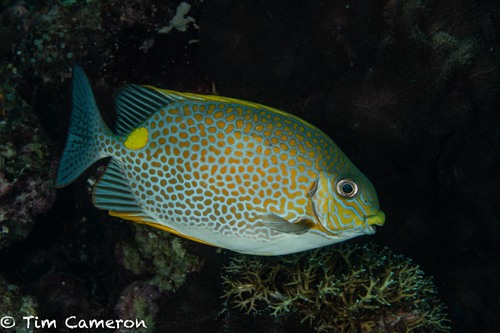
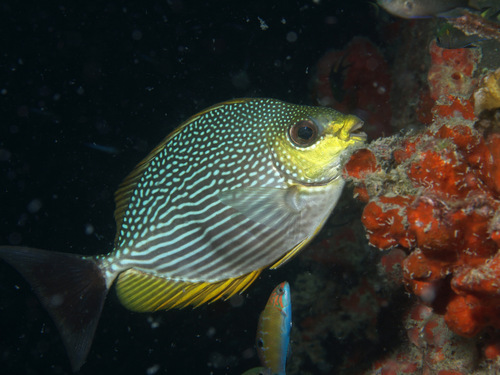
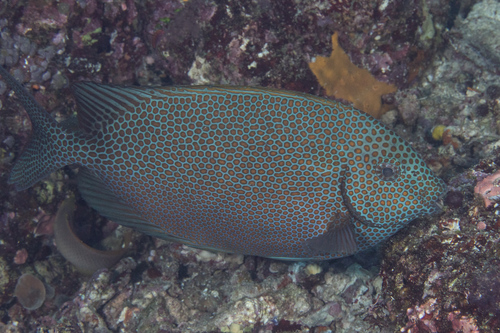
Siganus punctatus, the gold-spotted rabbitfish, has a laterally compressed deep body, where body depth is between 1.9 and 2.3 times the fish's standard length. The head has a straight dorsal profile that runs from the forehead to the snout at a 45-degree angle, while the ventral profile is slightly indented below the chin. In individuals smaller than 13 cm (5.1 in) in standard length, the front nostril bears a flap that extends halfway to the rear nostril; once the fish reaches 15 cm (5.9 in) in standard length, this flap is reduced to a low rim with a remaining posterior peak. A recumbent spine, embedded in the nape, sits in front of the dorsal fin. Like all rabbitfishes, the dorsal fin has 13 spines and 10 soft rays, while the anal fin has 7 spines and 9 soft rays. The fin spines are robust and contain venom glands. For individuals with a standard length less than 13 cm (5.1 in), the caudal fin is emarginate; as the fish grows, the caudal fin gradually becomes deeply forked, with broadly rounded tips on its lobes. This species reaches a maximum total length of 40 cm (16 in), with 30 cm (12 in) being the more common adult size. The fish's overall base color is greyish, with a dense pattern of brown spots that have darker margins covering the head, body, and fins. A pale saddle on the caudal peduncle and a large ocellus to the rear of the upper gill cover margin are sometimes present. Juvenile individuals have fewer, larger spots. The caudal fin very frequently has a very narrow yellow margin. This species has a wide distribution across the Indo-West Pacific. Its range extends from the Cocos (Keeling) Islands in the eastern Indian Ocean east to Samoa, north to Japan's Ryukyu and Ogasawara Islands, and south to Australia. In Australia, its range runs from Rottnest Island in Western Australia, north and east along the northern tropical coast, then south along the east coast as far as North West Solitary Island in New South Wales. It is also found at Rowley Shoals and Scott Reef off Western Australia, Ashmore Reef in the Timor Sea, and Coringa-Herald Cays and Lihou Reef in the Coral Sea. Adults occur at depths down to 40 m (130 ft) in clear lagoons and on seaward reefs, while juveniles form schools in estuaries.