About Siganus luridus (Rüppell, 1829)
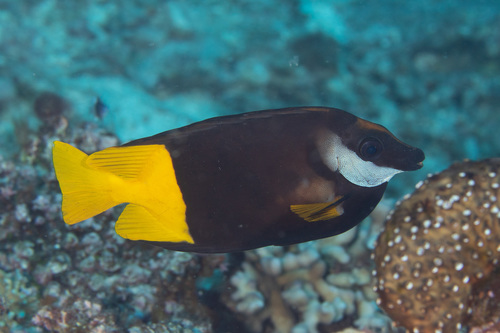
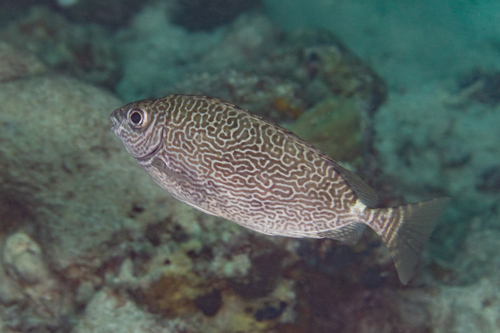
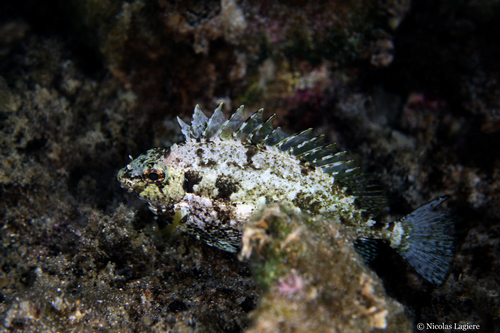
The dusky spinefoot, Siganus luridus, has a compressed body, with body depth ranging from 2.1 to 2.8 times its standard length. Its jaws hold a single row of incisor-like teeth, each bearing 1 or 2 lateral cusps. The dorsal fin has 13 to 14 spines and 10 soft rays, while the anal fin has 7 spines and 9 soft rays. The caudal fin is truncate. This species reaches a maximum total length of 30 cm (12 in), though 20 cm (7.9 in) is the more common typical size. Its colouration is variable, normally ranging from olive green to dark brown with a mottled pattern. The pectoral fins are hyaline-yellow, and dark bars mark the caudal fin.
The dusky spinefoot is distributed along the eastern African coast from Mozambique north into the Red Sea, and also occurs around the Comoros, Madagascar, and the Mascarene Islands. Its presence in the Persian Gulf has not yet been confirmed. It was first recorded in the Mediterranean Sea in 1955 off the coast of Israel, after entering via the Suez Canal. It has spread rapidly across the eastern Mediterranean Basin, and now reaches as far west as the French Mediterranean coast and the Adriatic Sea. It inhabits depths between 2 and 40 m (6 ft 7 in and 131 ft 3 in) in waters over hard substrates, such as coral and rocky reefs.