About Siganus lineatus (Valenciennes, 1835)
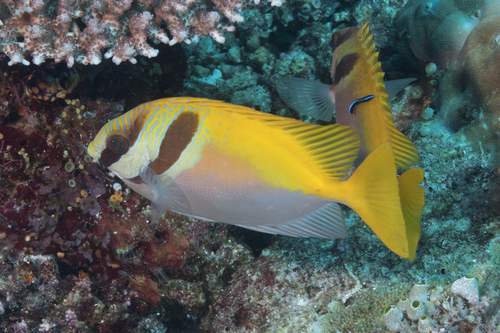
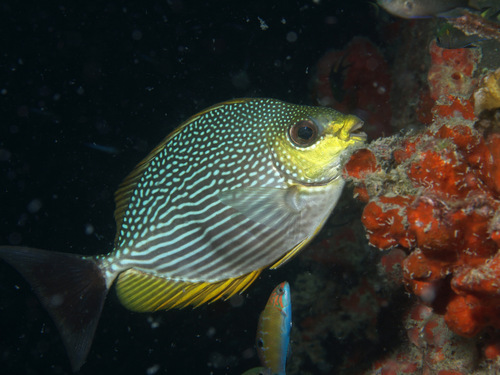
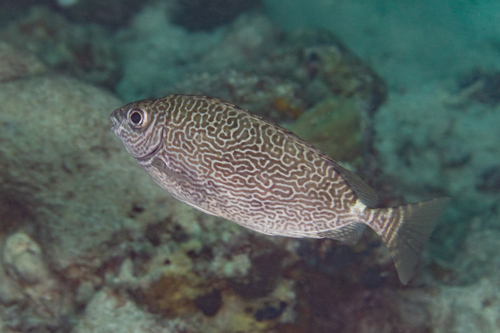
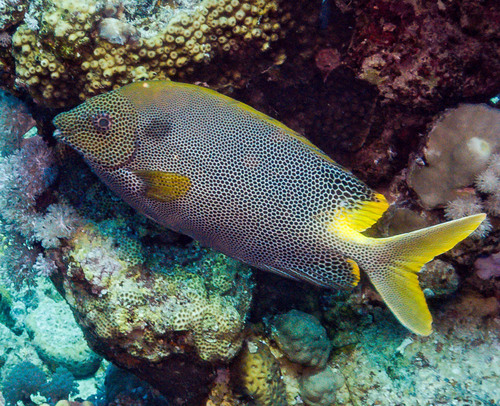
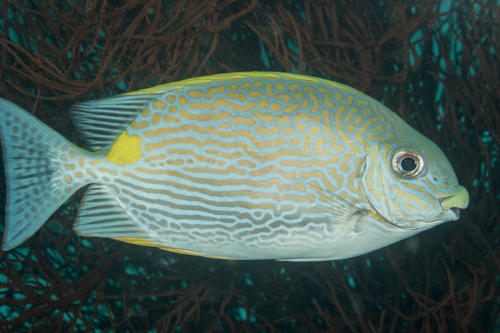
The golden-lined spinefoot, Siganus lineatus, has a laterally compressed body, with a body depth that is just over half its standard length. The dorsal profile of its head is steep, and there is a slight indentation above the eyes. The front nostril has a low rim that is larger on its rear side. A forward-pointing spine embedded in the nape sits in front of the dorsal fin. Like all rabbitfishes, this species has 13 spines and 10 soft rays in its dorsal fin, and 7 spines and 9 soft rays in its anal fin. Its caudal fin is emarginate to weakly forked. The maximum total length this species can reach is 43 cm (17 in), though a length of 25 cm (9.8 in) is more typical. The overall body colour of the golden-lined spinefoot ranges from pale grey to bluish-grey, fading to silvery on the abdomen. It is marked with wavy orange lines, has a large bright yellow spot underneath the soft-rayed portion of the dorsal fin, and blue lines on the cheek and operculum. The spines of the dorsal fin are golden with dusky bronze membranes, while the soft dorsal rays are silvery with bluish membranes between them, and each ray has a golden spot at its base. The anal fin spines are golden bronze with dusky blue membranes, and the anal fin soft rays are bluish with dusky membranes; each soft anal ray also has a golden spot at its base, plus a bar at the bottom of each membrane cell. The caudal fin is bluish with rows of golden spots that form 3 to 4 visible cross bars when the fin is furled. The outer spines and outermost fin ray of the pelvic fin are silvery, and all other pelvic fin structures are dusky blue. The pectoral fins are hyaline. The golden-lined spinefoot is distributed across the Indo-West Pacific, ranging from the Gulf of Thailand and the Philippines east to Vanuatu, and south to northern Australia. In Australia, it has been recorded from Point Quobba in Western Australia, east along the northern tropical coast to the Capricorn Group in southern Queensland, as well as at Ashmore Reef in the Timor Sea and Murray Island in the Coral Sea. It has also been reported from the Ogasawara, Europic and Caroline Islands. This species occurs at depths down to 25 m (82 ft), and lives in sheltered waters such as lagoons and bays. It can be found near rocky substrates or reefs, and often rests on rubble or sandy bottoms. Juveniles of this species prefer estuaries.