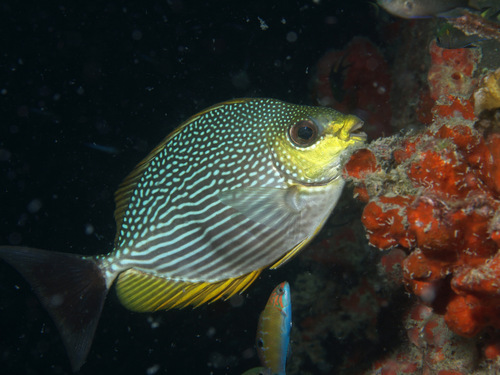
About Siganus javus (Linnaeus, 1766)
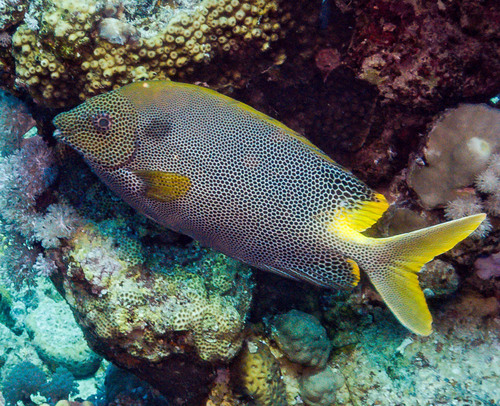
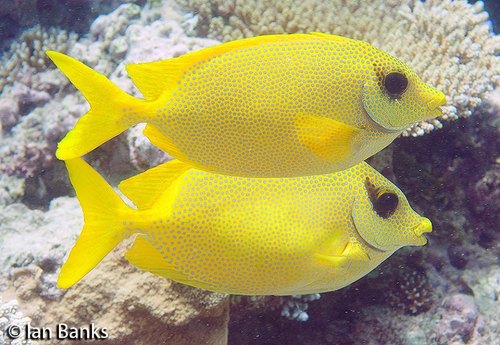
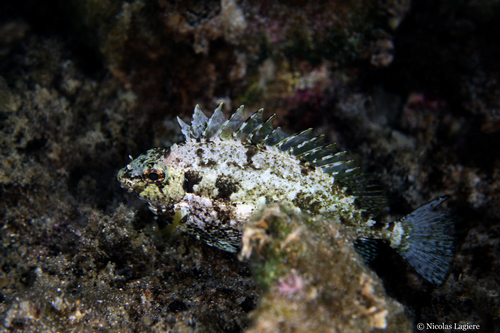
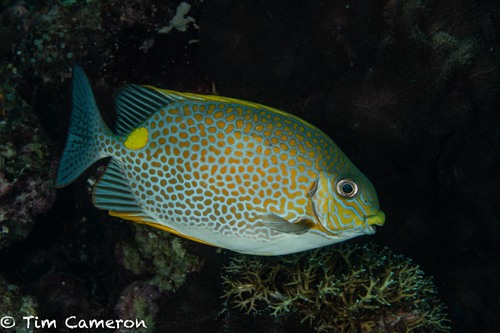
Siganus javus, commonly called the streaked spinefoot, has a laterally compressed body with a depth that measures just under half its standard length. Compared to other deep-bodied rabbitfishes, this species has a relatively small head, with a slight indentation above the eyes. The front nostril bears a small triangular flap that extends back halfway between the front and rear nostrils. A forward-pointing spine embedded in the nape sits in front of the dorsal fin. Like all rabbitfishes, the dorsal fin has 13 spines and 10 soft rays, while the anal fin has 7 spines and 9 soft rays. The caudal fin is emarginate. This species reaches a maximum total length of 53 cm (21 in), though 30 cm (12 in) is a more typical size. Its overall body colour is grey, fading to whitish on the lower body; the cheeks and lips are yellow. There are many small white spots across the head and upper body, and irregular sinuous stripes on the mid to lower flanks. A blackish area covers most of the caudal fin. The dorsal, anal, and pelvic fins have golden spines and rays, and their membranes can be dusky or golden. The pectoral fins are golden hyaline. The streaked spinefoot ranges from the Persian Gulf east to the Solomon Islands and Vanuatu, north to Taiwan, and south to northern Australia. In Australia, it has been recorded from Darwin, Northern Territory to north of Townsville in Queensland. There is one single record of this species from the Mediterranean Sea, where an individual was caught off Syria in 2009; the origin of this specimen is unknown. It occurs at depths between 1 m (3 ft 3 in) and 25 m (82 ft), and inhabits shallow coastal waters, brackish lagoons, rocky reefs, and coral reefs.