About Siganus guttatus (Bloch, 1787)
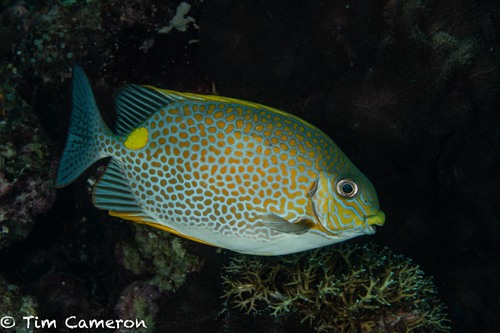
The orange-spotted spinefoot, Siganus guttatus, has a laterally compressed body, with a body depth equal to roughly half of its standard length. The dorsal profile of its head is quite steep, with a slight indentation just in front of the eyes. The front nostril has a slightly raised edge, which is larger on the rear edge. A forward-pointing spine sits in front of the dorsal fin, embedded in the nape. The dorsal fin contains 13 spines and 10 soft rays, while the anal fin contains 7 spines and 9 soft rays. The caudal fin is emarginate, becoming moderately forked in the largest individuals of this species. This species reaches a maximum total length of 42 cm (17 in), with a more typical total length of 25 cm (9.8 in). Its overall body coloration is dusky blue on the upper body and silvery on the lower body, with one large yellow-orange spot located below the soft-rayed section of the dorsal fin, near the caudal fin, plus a number of smaller reddish-brown spots across the flanks. This species has a wide distribution across the Indo-West Pacific, ranging from the Andaman Islands, the western coast of Peninsular Malaysia, and Sumatra east to West Papua, and north as far as the southern Ryukyu Islands. It is uncommon in Palau, and has also been recorded from Yap. Orange-spotted spinefoot occur in shallow coastal waters down to depths of 35 m (115 ft), where they live on reefs and in mangroves, and can tolerate a wide range of salinities.