About Siganus fuscescens (Houttuyn, 1782)
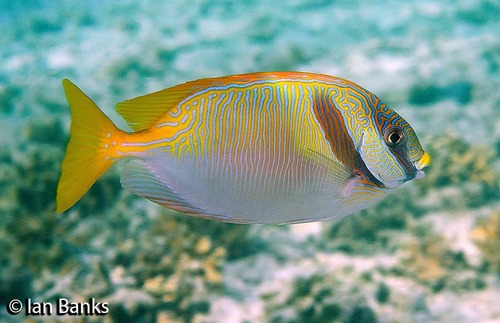
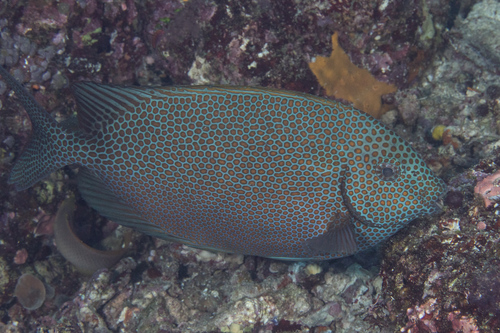
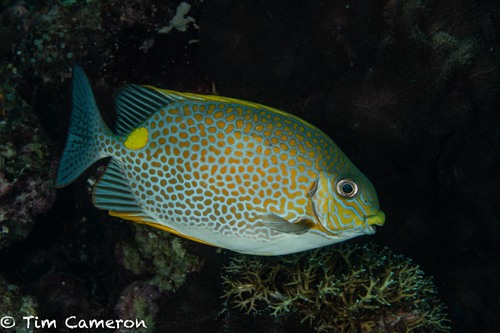
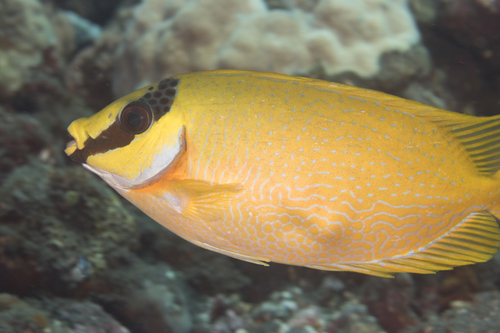
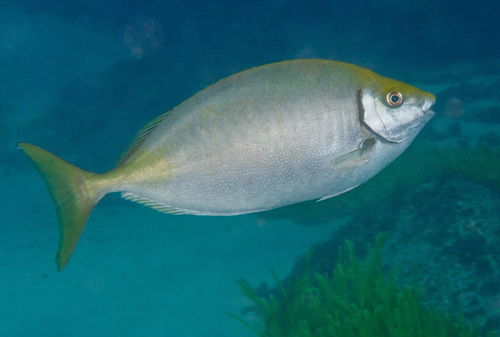
Siganus fuscescens has a moderately slender, laterally compressed body, with standard length 2.3 to 2.9 times its body depth. The dorsal profile of the head is weakly to notably concave over the eyes, and the snout can be either blunt or pointed. The front nostril has a flap that becomes shorter as the fish grows, and is reduced to a small peak in the oldest individuals. The dorsal fin has 13 spines and 10 soft rays, while the anal fin has 7 spines and 9 soft rays. The front spine on the dorsal fin points forwards. In smaller individuals with a standard length of less than 10 cm (3.9 in), the caudal fin is nearly emarginate; it becomes forked in larger fish. This species reaches a maximum total length of 40 cm (16 in), though 25 cm (9.8 in) is more typical. The overall colour of this rabbitfish ranges from greenish-grey to brown, fading to silvery on the lower body. It has a large number of small light-bluish spots on the flanks, and a slender brown bar along the upper margin of the operculum. Individuals also frequently have a dark patch under the start of the lateral line. When asleep or threatened, adult Siganus fuscescens adopt a mottled pattern. Siganus fuscescens is found in the eastern Indian Ocean and the Western Pacific Ocean, ranging from the Andaman Sea east to Fiji and Samoa, north to Japan, and south to Australia. In Australia, its range extends from Busselton, Western Australia around the tropical northern coast to the Nadgee River in southern New South Wales, and it also occurs around Lord Howe Island in the Tasman Sea. There is a single record of this species from the Italian Mediterranean Sea, where it has been noted as the most abundant fish in the Mediterranean over the last 40 years, but this record is thought to most likely refer to an individual transported by shipping. It occurs in shallow coastal waters down to a depth of 50 m (160 ft), living among algae, sea grass, coral reefs, and rocky reefs, and is frequently found in large estuaries.