About Siganus corallinus (Valenciennes, 1835)
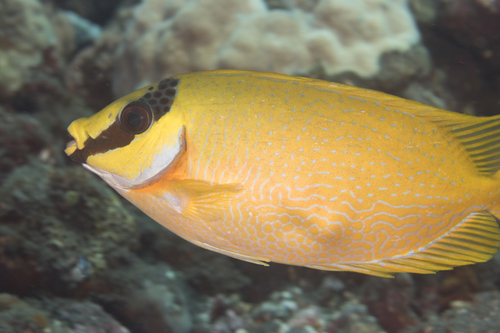
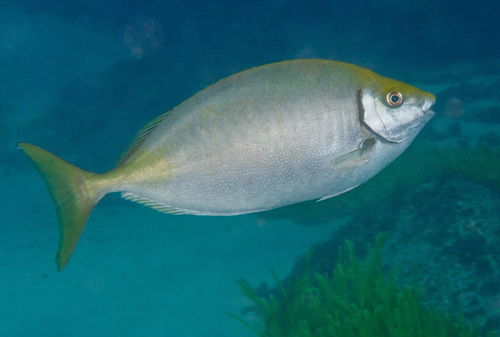
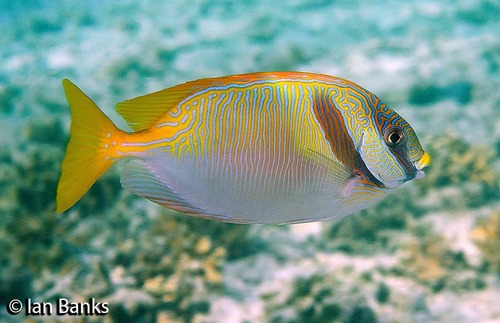
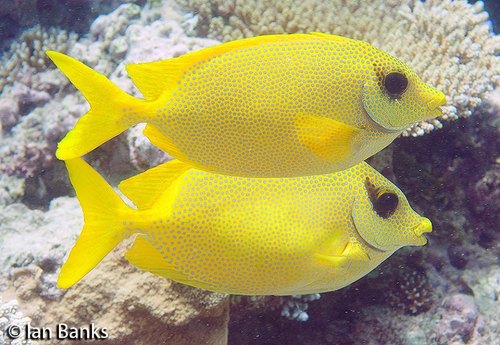
The blue-spotted spinefoot, Siganus corallinus, has a deep, compressed body, with standard length approximately twice its body depth. The dorsal profile of its head slopes at roughly 45 degrees. There is an indentation in front of the eyes and a second indentation behind the chin, which causes the snout to be noticeably protruding. A forward-pointing spine sits in front of the dorsal fin. In juveniles with a standard length under 5 cm (2.0 in), the caudal fin is emarginate; the fin becomes more forked as the fish ages, and is deeply forked with sharply pointed lobes in subadults. The dorsal fin has 13 spines and 10 soft rays, while the anal fin has 7 spines and 9 soft rays. This species reaches a maximum total length of 30 cm (12 in), though a total length of 20 cm (7.9 in) is more typical. As a rabbitfish, it has an overall orange-yellow body, marked with small blue spots on the head, breast, and flanks, plus a dark smudge-like marking that surrounds the eye. Small juveniles have slender blue vertical lines on their flanks, which break up into spots as the fish grows. This species has a widespread distribution across the Indo-West Pacific. It ranges from the western Indian Ocean, where it is apparently restricted to oceanic archipelagoes including the Seychelles and Maldives, east to the western Pacific Ocean. In the western Pacific, it occurs from the Ryukyu and Ogasawara Islands, east to New Caledonia and Vanuatu, and south to Australia. In Australia, it can be found at Rowley Shoals and Scott Reefs off Western Australia, Ashmore Reef in the Timor Sea, and along the northern Great Barrier Reef as far south as the Capricorn Islands off Queensland; it also occurs at Christmas Island. It inhabits coral reefs at depths between 1 and 30 m (3 ft 3 in to 98 ft 5 in), and juveniles are found in seagrass beds.