About Siganus canaliculatus (Park, 1797)
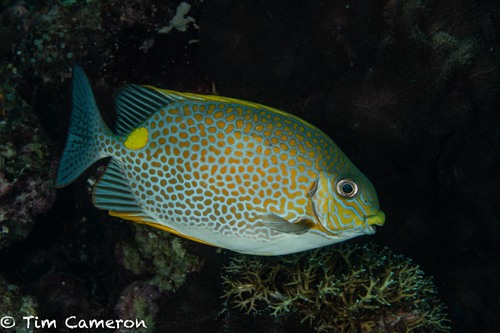
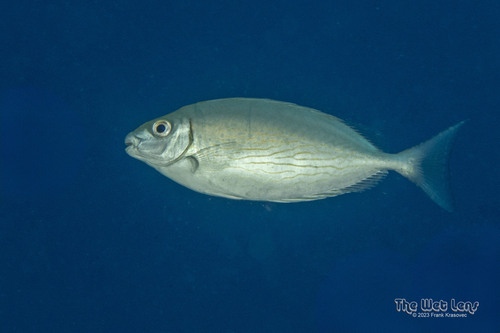
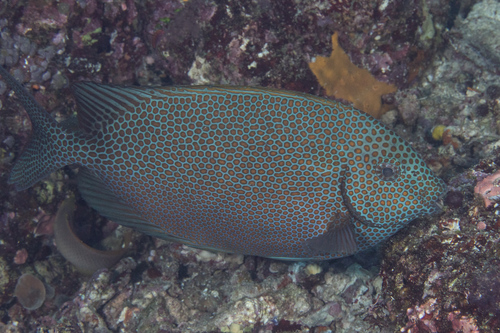
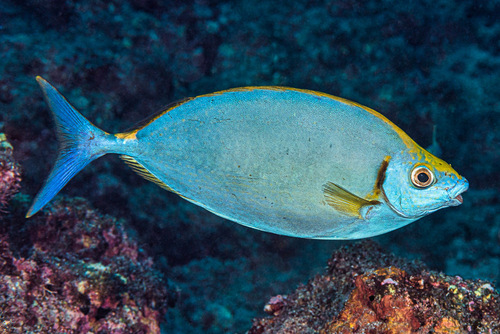
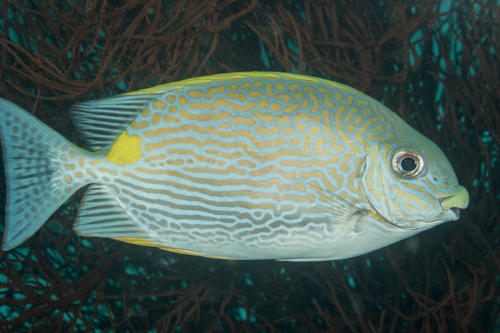
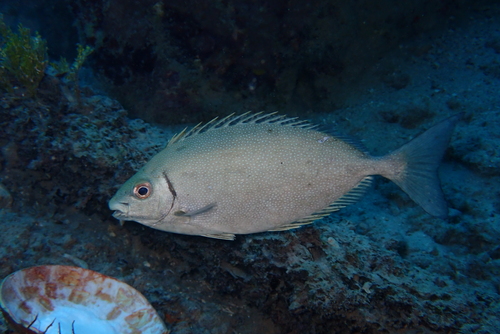
Siganus canaliculatus has a moderately slender, laterally compressed body, with a standard length 2.3 to 2.8 times its body depth. The dorsal profile of the head is weakly to notably concave above the eyes, and it has a pointed snout. The front nostril has a flap: in juvenile fish, this flap covers the rear nostril, but it shortens as the fish grows, and is completely absent in the oldest individuals. The dorsal fin has 13 spines and 10 soft rays, while the anal fin has 7 spines and 9 soft rays. The front spine of the dorsal fin points forwards. The caudal fin is nearly emarginate in smaller individuals with a standard length under 10 cm (3.9 in), and becomes forked in larger fish. This species reaches a maximum total length of 40 cm (16 in), though 20 cm (7.9 in) is more typical. The colour and pattern of the white-spotted spinefoot are very variable. Its body can range from greenish grey to yellow brown, and it is marked with 100 to 200 pearlescent blue to whitish spots on the nape and anterior body; on the lower flanks, these spots are similar in size to a match head. There are 2 to 3 rows of spots between the first dorsal fin spine and the lateral line; these spots are roughly one sixth the size of the eye. Another 10 or so rows of spots lie between the uppermost point of the lateral line and the base of the first anal fin spine. When alarmed or injured, this species develops a pattern of mottled light, dark brown, and cream patches on its flanks, forming 6 to 7 evenly spaced dark oblique zones separated by lighter zones of similar width. There is normally a dark spot immediately behind the upper end of the gill opening; this spot is about the same size as the eye, and there is also a thin bar along the upper margin of the operculum. Siganus canaliculatus has a wide distribution across the Indo-Pacific, ranging from the Persian Gulf to the Philippines and New Guinea, north to the Ryukyu Islands and south to northern Australia. It occurs at depths down to 50 m (160 ft). Adult fish live in inshore waters, on algae reefs, in estuaries, and in large lagoons where algae grows over rubble. Juveniles live on coral reef flats and in shallow bays. Siganus canaliculatus is an important target species for commercial fisheries. In the Persian Gulf, it is considered a good quality food fish, despite being a rather small species. It is caught using bottom trawls and seine nets in coastal waters throughout its range. In the Persian Gulf, most catches of this species are made via traps: fence nets set in the intertidal zone, and dome-shaped metal traps called gargoors. Large numbers of landed fish are sold fresh. This species is also caught as bycatch. The Teochew people of Singapore and Malaysia are particularly fond of this fish, which they call pek tor her, which translates to "white rabbit fish" in Chinese. It is typically steamed and eaten with rice, or served as part of a Teochew porridge meal. The white-spotted spinefoot is especially popular during Chinese New Year, when the fish is full of milt and roe, and eating it is considered auspicious. For this reason, it is also known as pai ni her, which translates to "Chinese New Year fish" in Chinese. The white-spotted spinefoot has been used for mariculture in some parts of its range, because it is herbivorous, grows quickly, and has high economic value. In some parts of the species' range, wild stocks have been overfished.