About Siganus argenteus (Quoy & Gaimard, 1825)
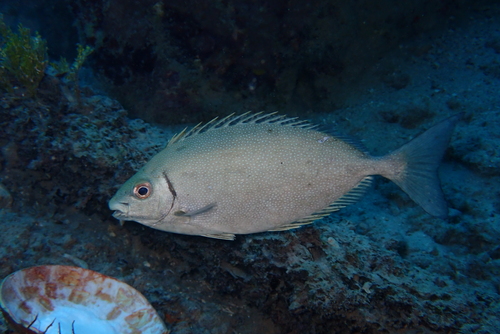
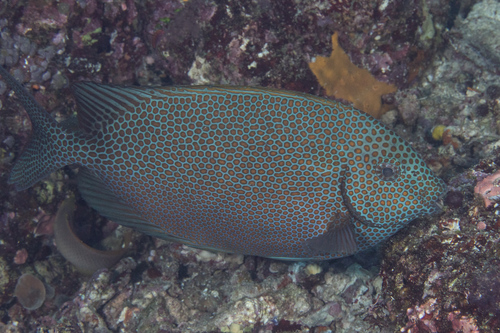
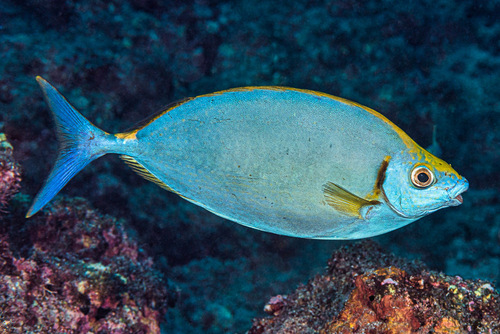
Siganus argenteus, commonly called the streamlined spinefoot, has an oval, compressed, slender, fusiform body. Its standard length is 2.4 to 3 times its body depth. The small head does not have a steep dorsal profile, and it has a pointed snout. A flap on the front nostril extends past the rear nostril. A procumbent spine at the front of the dorsal fin is enclosed in the skin of the nape. The dorsal fin has 13 spines and 10 soft rays, while the anal fin has 7 spines and 9 soft rays. The caudal fin is deeply forked. This species reaches a maximum total length of 40 cm (16 in), with 25 cm (9.8 in) being more typical. The upper body is blue, and the lower body is silvery. Individuals frequently have variable markings, spots, and curved lines, especially on the lower flanks. The iris of the eye is silvery-yellow. The axil of the pectoral fin is yellow, and there is usually a yellow stripe along the base of the dorsal fin. A dark brown bar sits on the upper edge of the operculum. When alarmed or asleep, this fish changes color to pale and dark brown mottling, with dark areas forming 7 diagonal zones across the flanks and mottled fins. The streamlined spinefoot has a wide Indo-Pacific distribution. Its range extends from the Red Sea south to Mozambique and Madagascar, and east into the Pacific Ocean as far as Pitcairn Island, north to Japan, and south to Australia. In Australia, it is distributed from Shark Bay in Western Australia to Ashmore Reef in the Timor Sea. On the east coast, it ranges from the northern Great Barrier Reef near Cape York south to Moreton Bay in Queensland, and it also occurs on reefs in the Coral Sea and at the Cocos (Keeling) Islands. It has been recorded once in the Mediterranean Sea off Libya, and it is uncertain how this specimen reached the area. On remote islands such as Rapa, Pitcairn, and the Line Islands, this species may be the only rabbitfish present. It occurs at depths down to 40 m (130 ft), and can be found in lagoons, on reefs, and in seaweed and seagrass beds.