About Siebenrockiella crassicollis (Gray, 1831)
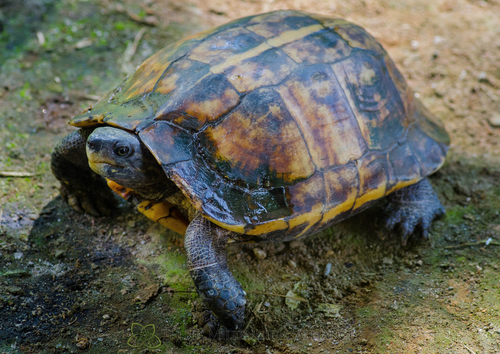
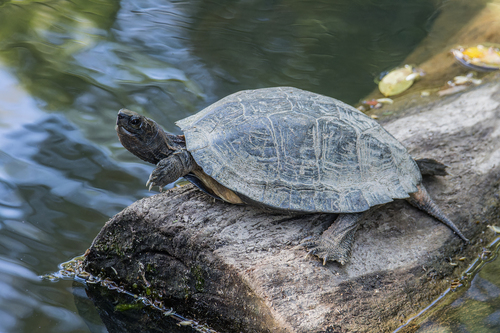
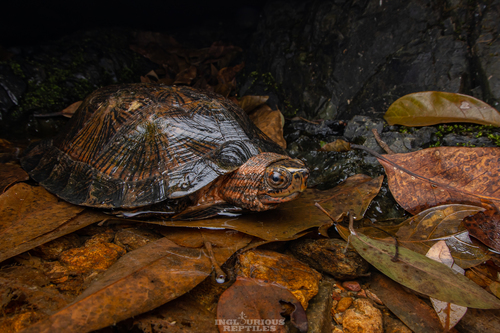
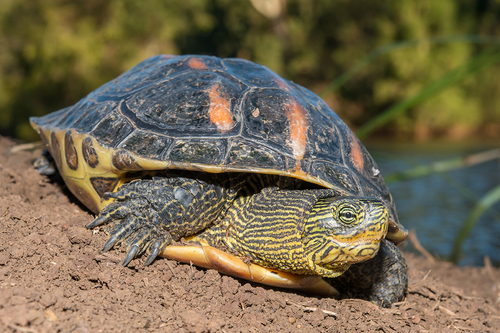
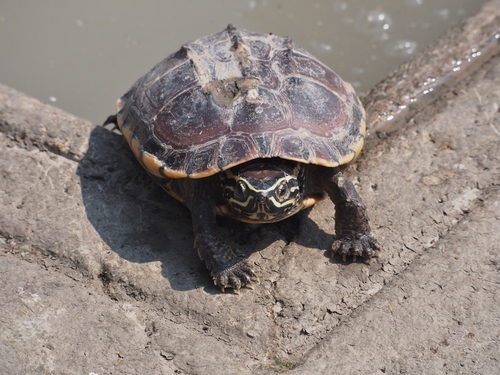
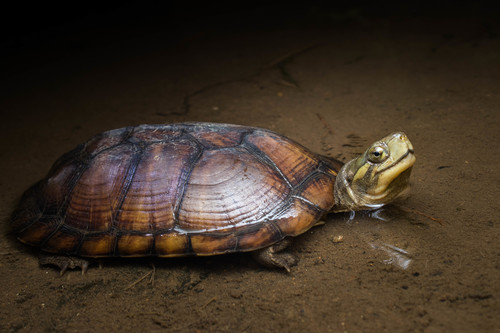
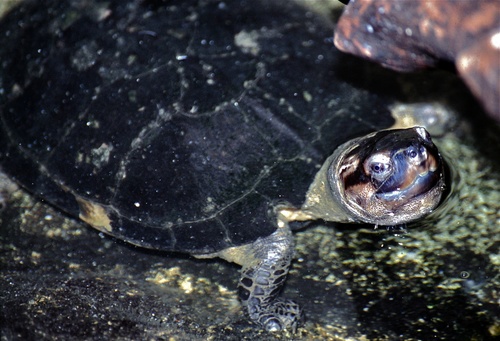
Adult black marsh turtles (Siebenrockiella crassicollis) are usually small to medium-sized, averaging around 17 cm (6.7 in) in length and rarely exceeding 20 cm (7.9 in), though some individuals grow to twice this maximum size. Their ovoid dorsal shell (carapace) is widest just behind its middle section, with a strongly serrated posterior margin. A prominent central keel runs down the middle of the carapace, and two less consistent lateral keels are also present. The carapace is almost entirely black or dark brown, with black radiating patterns. Their ventral shell (plastron) is not hinged and has a shallow U-shaped notch in its pair of anal scutes. The bridge, the section that connects the plastron's abdominal and pectoral scutes to the carapace, is roughly the same length as the rear part of the plastron made up of the femoral and anal scutes. Both the bridge and plastron may be entirely black, entirely dark brown, or yellowish with darker splotches or patterns. The forelimbs are covered in large transverse scales, and both forelimbs and hindlimbs are webbed, an adaptation for their largely aquatic lifestyle. Black marsh turtles have characteristically thick necks that form a collar around the head when the head is retracted into the shell. All limbs, the tail, and the neck are dark gray to black. The head is broad with a short, upward-pointed snout. The top of the head is mostly black, with cream to yellow markings around the eyes and throat, and a pair of pale white to yellow spots just behind the eardrum (tympanum) that are usually hidden by neck folds. Their powerful jaws are pale yellow to pale brown and curve upwards, which gives the species its common nickname 'smiling terrapin'.
Black marsh turtles are sexually dimorphic. Males have concave plastra, while females have flat plastra. The eye and throat markings present in all juveniles disappear in males when they reach adulthood, but are retained in females. Males also have longer, thicker tails than females. Black marsh turtles have a diploid karyotype of 52 chromosomes. They are notable as the first turtle found to use an XX/XY chromosomal sex determination system for macrochromosomes; this is very rare, as most turtle species determine developing embryo gender through environmental temperature.
Black marsh turtles are distributed across southern Vietnam, Cambodia, southern Myanmar (Tenasserim), central and peninsular Thailand, eastern and western Malaysia, Singapore, and the Indonesian islands of Java, Kalimantan, and Sumatra. A specimen found in the Cerucuk River on Belitung Island in May 2023 is the first official record of the species on the island, marking a significant range extension beyond previously recorded populations in Sumatra to the west and Borneo to the east. They inhabit slow-moving or stagnant warm waters with abundant vegetation, most commonly marshes, swamps, and ponds. As their common name suggests, they are primarily aquatic and prefer to stay buried in soft mud when they are not feeding.
Black marsh turtles are predominantly carnivorous and prefer to feed underwater. They prey on insects, worms, molluscs, amphibians, crustaceans, and small fish, though they will occasionally scavenge rotting plants, fruits, or carcasses of larger animals that fall into the water. Juveniles are typically more carnivorous than adult individuals. They are shy, mostly aquatic, nocturnal creatures. They will sometimes come onto land at night to forage or mate, and occasionally come out during the day to bask. Most of the time, they prefer to stay underwater, either partially buried in mud in shallow water or swimming near the bottom in deeper still waters. When threatened, black marsh turtles excrete a foul-smelling secretion from their cloaca to deter predators, and their powerful jaws can inflict wounds if they are handled roughly.
Black marsh turtles reach sexual maturity at five years old. Their nesting season falls in summer, between April and the end of June. During courtship, males bob their heads up and down while chasing a female, and may bite the female's legs multiple times before mating. Females lay three or four clutches per nesting season. Each clutch usually contains one, rarely two, relatively large eggs that measure around 5 by 3 cm (2.0 by 1.2 in) and weigh 30 g (0.066 lb). Eggs incubate for 68 to 84 days before hatching. Hatchlings are relatively large, measuring around 5 cm (2.0 in). The maximum observed lifespan of black marsh turtles in captivity is approximately 60 years.